



The GRASP lecture program is being developed in coordination with DIIA (Division of Instructional Innovation and Assessment) and CIT (Center for Instructional Technologies) at the University of Texas, Austin. Special thanks to Coco Kishi, Egan Jones and Mike DeLeon. GRASP is partially supported by NSF grant DMS-0449830 (CAREER).
Please write me your thoughts!
(A comment board and feedback format will appear soon.)
Look here for introductory materials on the Geometric Langlands program.
Wednesday March 1 2006, RLM 6.104
Noncommutative Projective Geometry
In recent years, a surprising number of significant insights and results in noncommutative algebra have been obtained by using the global techniques of projective algebraic geometry. This talk will survey some of these results. Thus we will be interested in using geometric techniques to study graded noncommutative rings.
Wednesday January 25 2006, RLM 6.104
Canonical bases for representations
A fundamental combinatorial question concerning Lie algebras is to calculate weight and tensor product multiplicities for their representations. The modern approach to this question is to construct special bases which are adapted to these calculations and then describe their combinatorics. There have been a number of constructions of such bases in the past 15 years, crystal bases by Kashiwara, canonical bases by Lusztig, the MV basis by Mirkovic-Vilonen, the basis given by components of quiver varieties by Nakajima, etc. Some of these construction are more representation theoretic, while others more geometric, however all are quite non-trivial. We will survey some of these constructions and discuss the resulting combinatorics.
Lecture Notes (by D. Ben-Zvi): pages 1, 2, 3, 4, 5, 6, 7, 8, 9.
Wednesday October 26, RLM 6.104
Introduction to Geometric Representation Theory, Part 1
Abstract: We'll explore the intimate relationship between the representation theory of Lie algebras and the geometry of flag varieties. In particular we'll consider the Borel-Weil theorem, identifying irreducible finite dimensional representations with line bundles, and the Beilinson-Bernstein theorem, identifying arbitrary representations with "sheaves with flat connection" (D-modules).
Wednesday September 7 2005
Jacob Lurie (Harvard U.) Bezout's theorem and nonabelian homological algebra (follow the link for QuickTime video and MP3 audio of the lecture)
Lecture Notes (by D. Ben-Zvi): pages 1, 2, 3, 4, 5, 6, 7, 8. See also the introduction to Lurie's thesis, in which Bezout's theorem and its nonabelian homological setting are discussed.
Abstract: We will begin with a review of the classical theorem of Bezout, which computes the number of intersection points of two algebraic curves in the projective plane, provided that they meet transversely. In the case of nontransverse intersections, one can make a similar assertion provided that one counts the intersection points with the correct multiplicities. The search for the correct intersection multiplicities will lead us into the world of "nonabelian homological algebra", a theory which is a mixture of classical algebra and homotopy theory.
Kevin McGerty (University of Chicago): Quivers and Lattices (follow link to QuickTime Video + Audio MP3), or Windows Media Player File [readable only through Internet Explorer]
Quivers and Lattices -- Lecture Notes by Kevin McGerty
Abstract: A quiver is simply a directed graph. By a representation of a quiver we mean a collection of vector spaces indexed by the nodes of the graph, together with linear maps corresponding to the arrows of the graph. We will introduce the notions of simple and indecomposable representations of a quiver (which may be considered part of the Abelian category structure of quiver representations). Gabriel asked which quivers have "finite representation type", that is, which quivers have finitely many indecomposables, and discovered a beautiful connection to Lie theory: The quivers with this property are precisely those whose underlying undirected graph is the Dynkin diagram of a Lie algebra. Moreover the indecomposable objects themselves are indexed by the roots of the associated Lie algebra. We will give an account of this theorem.
Wednesday December 7, RLM 6.104
Lagrangian Floer Theory Note: Due to a freak ice storm there is no video or audio available for this talk.
I will go over the definition of Floer homology for pairs of Lagrangian manifolds under suitable monotinicity assumptions, following Oh, and if time permits, discuss how these can be used to define categories of Lagrangian submanifolds (the Fukaya categories).
Lecture Notes (by D. Ben-Zvi): pages 1, 2, 3, 4, 5, 6, 7, 8.
Relativistic Mathematics. Note: Due to a technical calamity there is no video or audio available for this talk.
Lecture Notes (by D. Ben-Zvi): pages 1, 2, 3, 4.
Abstract: We will explore the role of the relative in mathematics, particularly in geometry. The prime impulse of twentieth century mathematics was a constant push to relativize, and many of the objects we now cherish (such as moduli spaces and mapping class groups) would not even make sense absent this point of view. We will sketch this development and try to explain how it constantly informs our mathematical instincts.
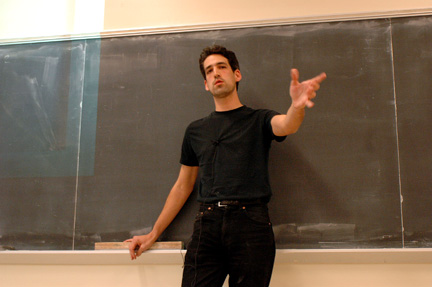
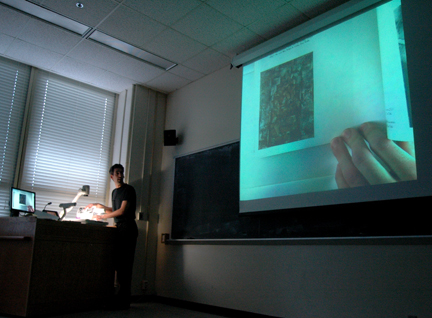
Photographs by Amber Novak
Department of Mathematics
University of Texas, Austin
Office 10.168
(512)471-8151
benzvi@math.utexas.edu
Up:
University of Texas, Austin Mathematics Department
Created: March 9 2005 --- Last modified: March 9 2005