VECTORS and MATRICES
By John Gilbert
Linear Algebra is a mathematical
framework, equally algebraic, computational and geometric, that can be
utilized throughout all applications of mathematics to science,
engineering, and computer science as well as business and economics once that
basic framework is in place. But what will we
need in its development? First we need both real and complex number
systems. Many matrices will have complex
entries as we shall see when we get to study eigenvalues and
eigenvectors.
A Complex number is an expression written in
the form $z = x+i y$ where $x,\, y$ are real,
i.e., in ${\mathbb R}$, and $i = \sqrt{-1}$ is a formal symbol
satisfying the relation $i^2 = -1$. We call $x = \text{Re}\,z$ the
real part and $y = \text{Im}\,z$ the imaginary
part of $z = x + i y$. So a real number $x$ is simply a complex number
with zero imaginary part, thus embedding ${\mathbb R}$ as a subset of
${\mathbb C}$. Formally, therefore, ${\mathbb C} = {\mathbb R} + i
\,{\mathbb R}$.
|
The Complex Number System is
the set ${\mathbb C}$ of all complex numbers with complex addition and
multiplication based on the usual rules of real arithmetic$\,:$
$$\eqalign{ (x+i y) + (u + i v) \ &= \ (x+u) + i (y + v),\\
(x + i y)(u + i v) \ &= \ (xu - yv) + i (xv + yu),}$$
together with the relation $i^2 = -1$. Multiplication is
commutative in the sense that $z w = w z$.
The complex conjugate of $z = x + i y$ is the
complex number $\overline{z} = x - i y$. In particular,
$$z\,\overline{z} \ = \ (x + iy)(x-iy) \ = \ x^2+y^2$$
is non-negative, so its square root exists and is called the modulus or
norm of $z\,$, written
$$\big|\,z\,\big| \ = \ \sqrt{x^2\,+\,y^2} \ = \ \big|\,z\,\overline{z}\,\big|^{1/2}\,.$$
|
The complex conjugate has a number of useful properties:
$$\text{Re}\,z \ = \ \frac{z +
\overline{z}}{2}, \qquad \text{Im}\,z \ = \ \frac{z -
\overline{z}}{2 i}, \qquad \overline{z + w} \ =\
\overline{z}+\overline{w}, \qquad \overline{zw} \ = \ \overline{z}\,\overline{w}\,.$$
Such properties are useful in simple computations
with complex numbers, for instance:
|
Problem 1: express the quotient $\, \displaystyle
{\frac{z_1}{z_2}}$ in the form $a + i b$ when
$$z_1 \ = \ 4 + 3 i,\qquad z_2 \ = \ 1 + 2 i
.$$
Solution: we use the fact that
$$ \frac{z_1}{z_2} \ = \ \frac{z_1
\overline{z_2}}{z_2 \overline{z_2}} \ = \ \frac{z_1
\overline{z_2}}{\big|\,z_2\,\big|^2},$$
|
so the denominator is now a real number.
For then
$$ \frac{z_1}{z_2} \ = \ \frac{(4 + 3
i)(1-2i)}{1^2 + 2^2}\qquad \qquad $$
$$\qquad \qquad = \ \frac{10 -5i}{5} \ = \ 2 -i\,.$$
|
|
Problem 2: write the expression $ \, \displaystyle
{\frac{z_1}{z_2} - \frac{z_1}{\overline{z_2}}}$ in the form
$a + i b$ when
$$z_1 \ = \ 2-i,\qquad z_2 \ = \ 1 + 2 i
.$$
Solution: we use the fact that
$$ \frac{z_1}{z_2} -
\frac{z_1}{\overline{z_2}} \ = \ \frac{z_1 \overline{z_2} - z_1
z_2}{z_2 \overline{z_2}},$$
so the denominator is now a real number.
|
But when $z_1 = 2-i,\
\ z_2 = 1 + 2 i
\,,$
$$z_1 \overline{z_2} - z_1z_2 \ = \
(2-i)(1-2i)\ = \ -4 - 8i\,,$$
while
$$ z_2 \overline{z_2} \ = \ (1+2i)(1-2i) \ =
\ 5\,.$$
Thus
$$ {\frac{z_1}{z_2} -
\frac{z_1}{\overline{z_2}}} \ = \ \frac{-4 - 8i}{5}\ = \
-\frac{4}{5} - \frac{8}{5}i\,.$$
|
The basic building blocks, however, are vectors and
matrices because they can be scaled, added, and multiplied -
that's where the
linear and the algebra both come in. We'll build on
many concepts you've learned already in one, two, and three
dimensions, but we'll certainly want to talk about
arbitrary (finite) dimensions, not just low dimensions, so definitions and
notation will need to be made for arbitrary dimension $n$ as much as
possible. Later things get even fancier because infinitely many
dimensions will be required, especially when we get to functions as vectors!
 A Vector is an ordered $n$-tuple of real numbers, a list
ordered downwards, and written as a column:
$$ \ \ {\bf v} \, =\,
\left[\begin{array}{cc} v_1 \\ v_2 \\ \vdots \\ v_{n} \end{array}\right].
$$
The entries of ${\bf v}$ are its components, and $v_j$
is called the $j^{th}$-component. The set of all such $n$-component
vectors will be
denoted by ${\mathbb R}^n$ - it's often called Euclidean
$n$-space just as we realized Euclidean $1$-space as
the number line, Euclidean $2$-space as the set of all ordered pairs
$(a,\, b)$, and $3$-space as the set of all ordered triples $(a,\,b,\,
c)$. Thus we will often realize ${\mathbb R}^n$ as the set of all
ordered $n$-tuples
$(a_1,\, a_2,\, \ldots,\, a_{n})$ of real numbers; then we can think and
speak of a point
$(a_1,\, a_2,\, \ldots,\, a_{n})$ as corresponding to the vector ${\bf a}$
whose components are $a_1,\, a_2,\, \ldots,\, a_{n}$ and vice
versa.
A Vector is an ordered $n$-tuple of real numbers, a list
ordered downwards, and written as a column:
$$ \ \ {\bf v} \, =\,
\left[\begin{array}{cc} v_1 \\ v_2 \\ \vdots \\ v_{n} \end{array}\right].
$$
The entries of ${\bf v}$ are its components, and $v_j$
is called the $j^{th}$-component. The set of all such $n$-component
vectors will be
denoted by ${\mathbb R}^n$ - it's often called Euclidean
$n$-space just as we realized Euclidean $1$-space as
the number line, Euclidean $2$-space as the set of all ordered pairs
$(a,\, b)$, and $3$-space as the set of all ordered triples $(a,\,b,\,
c)$. Thus we will often realize ${\mathbb R}^n$ as the set of all
ordered $n$-tuples
$(a_1,\, a_2,\, \ldots,\, a_{n})$ of real numbers; then we can think and
speak of a point
$(a_1,\, a_2,\, \ldots,\, a_{n})$ as corresponding to the vector ${\bf a}$
whose components are $a_1,\, a_2,\, \ldots,\, a_{n}$ and vice
versa.
The definitions of vector addition and scalar
multiplication in ${\mathbb R}^n$ for $n \le 3$ extend to arbitrary
$n$:
|
We add/subtract vectors ${\bf u},\ {\bf v}$ in ${\mathbb
R}^n$ by
$${\bf u} \pm {\bf v} \ = \
\left[\begin{array}{cc} u_1 \\
u_2 \\ \vdots \\ u_{n} \end{array} \right] \pm
\left[\begin{array}{cc} v_1 \\
v_2 \\ \vdots \\ v_{n} \end{array} \right] \ = \
\left[\begin{array}{cc} u_1 \pm v_1 \\
u_2 \pm v_2 \\ \vdots \\ u_{n} \pm v_{n} \end{array}
\right]\,,$$
|
and form the scalar multiple $k {\bf v}$ of $k$ in ${\mathbb R}$
and ${\bf v}$ in ${\mathbb R}^n$ by
$$k{\bf v} \ = \ k\left[\begin{array}{cc} v_1 \\
v_2 \\ \vdots \\ v_{n} \end{array} \right] \ = \ \left[\begin{array}{cc} kv_1 \\
kv_2 \\ \vdots \\ kv_{n} \end{array} \right]\,;$$
|
in other words, calculations are done
component-wise. For example, in ${\mathbb R}^4$
$$ 3{\bf u} - 5 {\bf v} \ = \ 3\left[\begin{array}{cc} 2 \\
-1 \\ 3\\ 7 \end{array} \right] -5 \left[\begin{array}{cc} 4 \\
-2 \\ 2 \\ 3 \end{array} \right] \ = \ \left[\begin{array}{cc} 6 \\
-3 \\ 9\\ 21 \end{array} \right] - \left[\begin{array}{cc} 20 \\
-10 \\ 10 \\ 15 \end{array} \right] \ = \
\left[\begin{array}{cc} -14 \\
7 \\ -1 \\ 6 \end{array}
\right].$$
General vectors in ${\mathbb R}^n$ have the
properties:
|
Theorem 1.1 Algebraic properties of vectors in
${\mathbb R}^n$: when ${\bf u},\, {\bf v},\, {\bf w}$ are
vectors in ${\mathbb R}^n$ and $c,\, d$ are scalars, then
$ \quad {\bf u}\, + \, {\bf v} \ = \ {\bf
v} \, + \, {\bf u} \qquad \qquad \qquad \qquad \qquad \qquad $ (commutativity)
$ \quad ({\bf u} + {\bf v})+{\bf w} \,=\, {\bf
u} +( {\bf v} + {\bf w}) \qquad \qquad \qquad \qquad $ (associativity)
$ \quad {\bf u}\, + \, {\bf 0} \ = \ {\bf
u},\qquad {\bf u} + (-{\bf u}) \,=\, {\bf 0} \qquad \qquad \qquad $
(zero vector properties)
$ \quad c({\bf u}\, + \, {\bf v}) \ = \ c{\bf
u} \, + \, c{\bf v} \qquad \qquad \qquad \qquad \qquad \qquad $ (distributivity)
$ \quad (c + d){\bf u} \ = \ c{\bf
u} \, + \, d{\bf u} \qquad \qquad \qquad \qquad \qquad \qquad $ (distributivity)
$ \quad c({d\,\bf u}) = (cd)\,{\bf u}\,, \quad 1\,{\bf u}=
{\bf u}\,, \quad 0\,{\bf u} = {\bf 0} \qquad $
(scalar multiplication properties)
|
Length, distance, and perpendicularity imposes a (Euclidean)
geometry on ${\mathbb R}^n$ via a Dot Product.
|
Definition 1.1: the DOT PRODUCT of
vectors
$${\bf u}\ = \ \left[\begin{array}{cc} u_1 \\
u_2 \\ \vdots \\ u_{n} \end{array} \right], \qquad \qquad {\bf v} \ =
\ \left[\begin{array}{cc} v_1 \\
v_2 \\ \vdots \\ v_{n} \end{array} \right],$$
in ${\mathbb R}^n$ is defined by
$${\bf u} \cdot {\bf v} \ = \ u_1 v_1 + u_2 v_2 + \ldots + u_{n}
v_{n}\,.$$
Two vectors ${\bf u},\ {\bf v}$ are said to be
Orthogonal or ( Perpendicular) when ${\bf u} \cdot
{\bf v} \,=\, 0$. The term INNER PRODUCT is often
used instead of dot product.
|
Several very useful properties - all familiar from
the standard dot product on ${\mathbb R}^3$ - follow from this
definition.
|
Property 1.1: for vectors ${\bf u},\ {\bf v},\
{\bf w}$ in ${\mathbb R}^n$ and scalars $a,\, b,$
 ${\bf u}\cdot{\bf v} \ = \ {\bf v}\cdot{\bf u}\,,$
|
$ (a{\bf u} + b {\bf v}) \cdot {\bf w} \ = \ a\,{\bf
u}\cdot{\bf w} + b\,{\bf v}\cdot{\bf w}\,,$
${\bf u}\cdot{\bf u} \ \ge \ 0\,,$
${\bf u}\cdot{\bf u} \ = \ 0\,,\ $ if and only if $\, {\bf u}
\,=\, {\bf 0}\,.$
|
Since ${\bf v} \cdot {\bf v} \ge 0$, the square root
$\sqrt{{\bf v} \cdot {\bf v}}$ is defined for all ${\bf v}$, so the
definition of the length of a vector in $2$- and
$3$-space extends to ${\mathbb R}^n$.
|
Definition 1.2:
the LENGTH of a vector ${\bf v}$ in ${\mathbb R}^n$, often referred
to as the NORM of ${\bf v}$, is the scalar defined by
$$\| {\bf v}\| \ = \ \sqrt{{\bf v}\cdot {\bf v}} \ = \ \sqrt{ v_1^2 + v_2^2 +
\dots + v_{n}^2}\,.$$
The DISTANCE
$$\text{dist}({\bf u},\, {\bf v}) \ = \ \| {\bf u} - {\bf v}\|$$
between vectors $ {\bf u},\, {\bf v }$ in ${\mathbb R}^n$ is the
length of the vector $\,{\bf u} - {\bf v}$.
|
The ANGLE $\theta$ between non-zero vectors ${\bf
u},\, {\bf v}$ can then be introduced using the
definition of dot product:
$$\cos \theta \ = \ \frac {{\bf u} \cdot {\bf
v}}{\|{\bf u}\| \|{\bf v}\|}. $$
(Note that $\|{\bf v}\| = 0 \ \Longleftrightarrow \ {\bf v} = {\bf 0}$, so
this definition makes sense.)
Now let's examine matrices:
An $m \times n$ MATRIX with real entries
is a set of $mn$ real numbers $a_{jk},\, 1 \le j\le m,\ 1 \le k \le
n,\,$ listed either as an
Array with $m$ rows and $n$ columns or as a row of
$n$ column vectors or a column of
$m$ row vectors as shown in
$$ A \ = \ \left[\begin{array}{cc}
a_{11} & a_{12} & a_{13} & \cdots & a_{1,\,n} \\
a_{21} & a_{22} & a_{23} & \cdots & a_{2,\,n} \\
a_{31} & a_{32} & a_{33} & \cdots & a_{3,\, n} \\
\vdots & \vdots & \vdots & \ddots & \vdots \\
a_{m,\,1} & a_{m,\, 2} & a_{m,\,3} & \cdots & a_{m,\, n}
\end{array}\right] \ = \ \big[\begin{array}{cc} {\bf a}_1 & {\bf a}_2 &
\ldots & {\bf a}_{n}\\ \end{array}\big] $$
where
$${\bf a}_1 \,=\, \left[\begin{array}{cc} a_{11} \\
a_{21} \\ \vdots \\ a_{m,\,1} \end{array} \right]\,, \qquad {\bf a}_2 \,=\, \left[\begin{array}{cc} a_{12} \\
a_{22} \\ \vdots \\ a_{m,\,1} \end{array} \right]\,, \qquad \ldots \,,
\qquad {\bf a}_{n} \,=\, \left[\begin{array}{cc} a_{1,\,n} \\
a_{2,\, n} \\ \vdots \\ a_{m,\,n} \end{array} \right]$$
are column vectors in ${\mathbb R}^m$. These definitions will be
used interchangeably. To keep from drowning in notation, however, it's
common to write a matrix as $A = [a_{jk}]$ instead of writing out all
the entries in $A$. The set of all $m \times n$ matrices with real entries will be
denoted by $M_{m \times n}({\mathbb R})$. Notice that $M_{m \times 1}({\mathbb R})$ is just
another way of thinking of ${\mathbb R}^m$.
Addition and scalar multiplication of matrices are
defined:
|
We add/subtract matrices $A,\, B$ in $M_{m \times n}({\mathbb R})$ entry-by-entry:
$$A \pm B \ = \ [a_{jk}] \pm [b_{jk}] \ = \
[a_{jk} \pm b_{jk}] \,.$$
In particular, $A \pm B$ is defined only when both $A,\, B$ are
$m \times n$, i.e., have the same shape, and then $A
\pm B$ also has the same shape because it is $m \times n$. For example,
$$\left[\begin{array}{cc} 1 & 2 & 3 \\ -3 & 4 & -1\end{array}\right]
+ \left[\begin{array}{cc} 4 & -1 & 1 \\ 2 & -4 &
-1\end{array}\right]\ = \ \left[\begin{array}{cc} 5 & 1 & 4 \\ -1 &
0 & -2\end{array}\right],$$
$$\left[\begin{array}{cc} 1 & 2 & 3 \\ -3 & 4 & -1\end{array}\right]
- \left[\begin{array}{cc} 4 & -1 & 1 \\ 2 & -4 &
-1\end{array}\right]\ = \ \left[\begin{array}{cc} -3 & 3 & 2 \\ -5 & 8 & 0\end{array}\right]$$
|
We define the scalar multiple of $k$ in ${\mathbb R}$
and $A$
in $M_{m \times n}({\mathbb R})$ by
$$k A \ = \ k [a_{jk}] \ = \ [k a_{jk}]\,.$$
Thus each entry in $A$ is multipled by $k$; in particular, the scalar
multiple $k A$ of an $m \times n$ matrix $A$ also is $m \times
n$, so scalar multiplication preserves shape too because the
scalar multiple $k A$ is again $m \times n$. For example,
$$3 \left[\begin{array}{cc} 1 & 2 & 3 \\ -3 & 4 &
-1\end{array}\right]\ = \ \left[\begin{array}{cc} 3 & 6 & 9 \\ -9 & 12 &
-3\end{array}\right]\,.$$
|
Matrices have the same algebraic properties listed in
Theorem 1.1 that vectors have. To introduce multiplication, let's begin with the
product of a matrix and a vector:
|
Definition 1.3 Matrix-vector Rule: if $A=\big[{\bf a}_1\ {\bf
a}_2 \ \ldots {\bf a}_{n} ]$ is an $m \times n$ matrix written as $n$
column vectors $ {\bf a}_1,\, {\bf a}_2,\,
\dots,\, {\bf a}_{n}$ in ${\mathbb R}^m$ and ${\bf x}$ is a vector in
${\mathbb R}^n$, then $A{\bf x}$ is the vector $A {\bf x}$ in
${\mathbb R}^m$ defined by
$$A\,{\bf x} \ = \ \big[{\bf a}_1\ {\bf
a}_2 \ \ldots {\bf a}_{n} ] \left[\begin{array}{cc} x_1 \\ x_2 \\
\vdots \\ x_{n} \end{array} \right] \ = \ x_1 {\bf a}_1 + x_2 {\bf
a}_2 + \ldots + x_{n} {\bf a}_{n}. $$
Thus the product of an $m \times n$ matrix $A$ and a
vector ${\bf x}$ in ${\mathbb
R}^n$ is a vector $A {\bf x}$ in
${\mathbb R}^m$. (Note carefully how $m$ and $n$ enter into the
definition of this product!)
|
Collecting all these concepts together we can thus solve:
|
Problem 1.3 : determine the vector
$${\bf v}\ = \ \left[\begin{array}{cc} 2 & 1
\\ 4 & 2 \end{array}\right] \left[\begin{array}{cc} 2 \\
3\end{array}\right] - 5 \left[\begin{array}{cc} 1 \\
3\end{array}\right] $$
in ${\mathbb R}^2$.
Solution: by the matrix-vector rule,
|
$$ \left[\begin{array}{cc} 2 & 1
\\ 4 & 2 \end{array}\right] \left[\begin{array}{cc} 2 \\
3\end{array}\right] \ = \ 2 \left[\begin{array}{cc} 2 \\
4\end{array}\right] + 3 \left[\begin{array}{cc} 1 \\
2\end{array}\right] \ = \ \left[\begin{array}{cc}7\\ 14
\end{array}\right].$$
So
$${\bf v} \ = \ \left[\begin{array}{cc}7\\ 14
\end{array}\right] - 5 \left[\begin{array}{cc} 1 \\
3\end{array}\right] \ = \ \left[\begin{array}{cc} 2 \\
-1\end{array}\right]. $$
|
So far we've added and subtracted two $m \times n$
matrices $A,\, B$ to form a new matrix $A \pm B$; we've also formed
scalar multiples $k A$. Both matrix addition and scalar
multiplication thus produced an $m \times
n$ matrix from $m \times n$ matrices, and all this enabled us to form
Linear Combinations $cA + d B$ of matrices in $M_{m \times n}({\mathbb R})$ just
as we formed linear combinations of vectors in ${\mathbb R}^n$. In addition, using the
Matrix-Vector Rule, we even learned how to multiply an $m \times n$ matrix $A$
and a vector ${\bf x}$ in ${\mathbb R}^n$:
$$A {\bf x} \ = \ [ {\bf a}_1\ \ {\bf a}_2\ \
\ldots \ \ {\bf a}_{n} ]\left[\begin{array}{cc} x_1 \\ x_2 \\ \vdots \\
x_{n} \end{array} \right] \ = \ x_1 {\bf a}_1 + x_2 {\bf a}_2 + \ldots +
x_{n} {\bf a}_{n}\,,$$
producing a vector in ${\mathbb R}^m$. It will be crucial, however, to learn when and how to multiply
matrices $A,\, B$ to form the matrix product $AB$ more
generally. Recall that it's often convenient to denote the
$(j,\,k)^{\small{\hbox{th}}}$-entry in a matrix $A$ by $a_{jk},\, (A)_{jk}$ or
$A_{jk}$.
|
Row-Column Rule: if $A=\big[a_{jk}\big]$ is an $m
\times p$-matrix and $B= \big[b_{jk}\big]$ is a $p \times n$-matrix,
then the product $AB$ is the $m \times n$-matrix whose
$(j,k)^{\text{th}}$-entry is given by
$$(AB)_{jk} \ = \ a_{j1}b_{1k} \,+\, a_{j2}b_{2k} \,+\, \ldots \,+
a_{j,\,p}b_{p,\,k} \,.$$
The expression $(AB)_{jk}$ can be also written more compactly
in summation notation as
$$(AB)_{jk} \ = \ \sum_{r = 1}^{p}\ a_{jr}b_{rk} \,.$$
Crucially, the matrix product $AB$ is defined when $A$ is $m \times
p$ and $B$ is $p \times n$; the product $AB$ is then an $m \times n$ matrix.
|
For example,
|
Suppose we wish to calculate, say, the $(1,3)$-entry in the product
$AB$ of the matrices
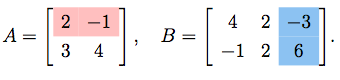
To use the row-column method we'll need to take the
elements in the ${\bf r}_1$ row in $A$, highlighted in pink, with the
corresponding entries in the ${\bf a}_3$ column in $B$, highlighted in
blue, and sum the products of the respective entries.
Thus, as highlighted in green, the $(1,3)$-entry in
|
the matrix product $AB$ is given by

The remaining entries can now be computed in the same way, showing
that the matrix product $AB$ is the $2 \times 3$ matrix
$$ \left[\begin{array}{cc} 2 & -1 \\ 3 & 4
\end{array}\right]\, \left[\begin{array}{cc} 4 & 2 & -3
\\ -1 & 2 & 6 \end{array} \right] \ = \ \left[\begin{array}{cc} 9 & 2 & -12
\\ 8 & 14 & 15 \end{array} \right]\,.$$
For large values of $m,\, n$ use technology!
|
By using the Row-Column Rule definition together with the familar
algebra of real numbers we can use
straightforward calculations to show that many of the familiar
multiplicative properties of real numbers carry over to matrix multiplication.
|
Theorem 7.1 Properties of Matrix
Multiplication: when $A,\, B, C$ are
matrices $($whose sizes allow the given operations to be
performed$)$ and $k$ is a scalar, then
$ \quad A(B C) \ = \ (A B) C \qquad \qquad \qquad \qquad \quad
\qquad \qquad $ (associativity)
$ \quad A(B + C)\ = \ AB + AC \qquad \qquad \qquad \qquad \qquad $ (left distributivity)
$ \quad (A + B )C \ = \ AC + BC \qquad \qquad \qquad \qquad \qquad $
(right distributivity)
$ \quad$ if $A$ is $m \times n$, then $I_m A \ = \ A \ = \ A I_n \qquad \qquad $
(multiplicative identity)
$ \quad k(AB)\ = \ (k A)B\ = \ A(k B) \qquad \qquad \qquad $
(scalar multiplication properties)
|
But it's very important to notice that some
multiplicative properties of real numbers do not carry over to
matrices:
|
Commutativity: the equality $AB = BA$ need not hold
for matrices $A,\, B$ .
For example,
$$ AB \ = \ \left[\begin{array}{cc} 0 & 1 \\
0 & 2 \end{array}\right] \left[\begin{array}{cc} 0 & 2 \\
0 & 1 \end{array}\right] \ = \ \left[\begin{array}{cc} 0 & 1 \\
0 & 2 \end{array}\right],$$
while
$$ BA \ = \ \left[\begin{array}{cc} 0 & 2 \\
0 & 1 \end{array}\right] \left[\begin{array}{cc} 0 & 1 \\
0 & 2 \end{array}\right] \ = \ \left[\begin{array}{cc} 0 & 4 \\
0 & 2 \end{array}\right].$$
|
Zero Divisors: when $AB = 0$, then neither $A$, nor
$B$, need be the $0$-matrix.
For example, when
$$ A \ = \ \left[\begin{array}{cc} 0 & 1 \\
0 & 0 \end{array}\right], \qquad B\ = \ \left[\begin{array}{cc} 0 & 2 \\
0 & 0 \end{array}\right],$$
then
$$ AB \ = \ \left[\begin{array}{cc} 0 & 1 \\
0 & 0 \end{array}\right] \left[\begin{array}{cc} 0 & 2 \\
0 & 0 \end{array}\right] \ = \ \left[\begin{array}{cc} 0 &0 \\
0 & 0 \end{array}\right].$$
|
Thus the term 'linear algebra' has two basic
components. The first is the 'linear' half. Given vectors ${\bf u},\, {\bf v}$
(resp. matrices $A,\, B$) and
scalars $c,\, d$, then the Linear Combination $a{\bf u} + b{\bf
v}$ (resp. $cA + d A$) is again a vector (resp. matrix) which can be defined
component-wise. But recall that you also met linear combinations $af(x) + b g(x)$ of
functions when dealing with properties of limits, derivatives and
integrals. In fact, Linearity is a
fundamental concept occuring everywhere in mathematics and its applications.
We formalize these ideas
abstractly by introducing the notion of Vector space.
The second key component is the 'algebra' half: the
familiar algebraic properties of addition and
multiplication that real numbers have were passed on to matrices. But matrices
with entries other than real numbers - complex numbers, functions,
matrices etc. - could be allowed. So defining operations
entry-by-entry allows matrices to inherit the algebra of their individual
entries when we are careful! This is extremely important in practice -
together with the availability everywhere of computational
facilities it is why linear algebra is fundamental to everything we do
these days.