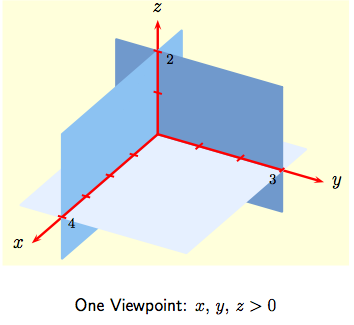
Calculus for functions $z = f(x,\,y)$ of two (or more) variables relies heavily on what you already know about the calculus of functions $y = f(y)$ of one variable. Since the graph of a function $z = f(x,\, y)$ of a function of two variables is a surface in $3$-space we'll have to introduce suitable coordinate systems in $3$-space. The first one is the Cartesian $xyz$-coordinate system obtained by adding the $ z$-axis perpendicular to the usual $ xy$-coordinate system in the $xy$-plane.
|
Each point $P$ in $3$-space is determined by a triple
$(a,\, b,\, c)$ as shown to the right. The three coordinate
axes intersect at the origin, and each pair of axes determines a
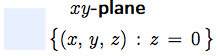
coordinate plane. The $x$- and $y$-axes determine the
$xy$-plane shown in light blue, for example.
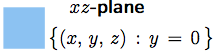
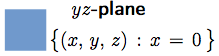
If we drop a perpendicular from $P$ to the the $xy$-plane, we get a point $Q$ with coordinates $(a,\,b,\, 0)$ called the projection of $P$ on the $xy$-plane. In the same way there are projections $R(0,\,b,\,c)$ and $S(a,\,0,\,c)$ of $P$ on the $yz$-plane and $zx$-plane respectively. |
|
|
|
|
|
|
|
|
|
Example 1: find the distance of the point $P(5,\,4,\, 7)$ from the plane
$z = 3$.
Solution: the plane $z = 3$ shown in green is parallel to the plane $z = 0$, in other words to the $xy$-plane. It consists of all points with coordinates $(x,\,y,\, 3)$. So its graph is the one shown to the right, and $P$ lies above the plane $z = 3$. The distance of $P(5,\,4,\,7)$ from the plane $z = 3$ is the length of the dark blue line. Thus $$\hbox{distance}\{(5,\, 4,\, 7), \, z=3\} \ = \ 7 - 3 \ = \ 4 \,.$$ |
|