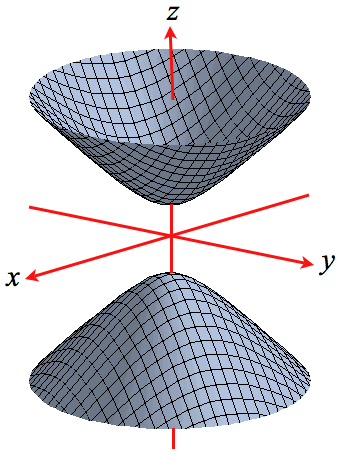
 $$ x^2+y^2-z^2 \,=\,-1$$
Two-sheeted Hyperboloid
$$ x^2+y^2-z^2 \,=\,-1$$
Two-sheeted Hyperboloid
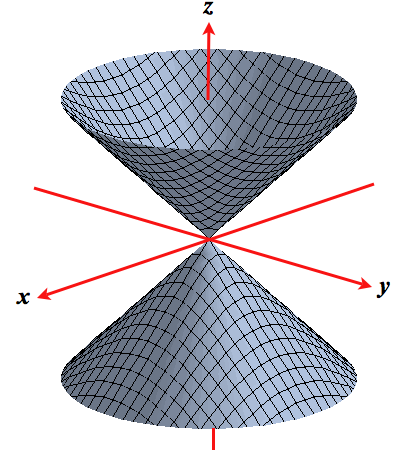
$$x^2+y^2 - z^2 \,=\, 0$$
Double Cone
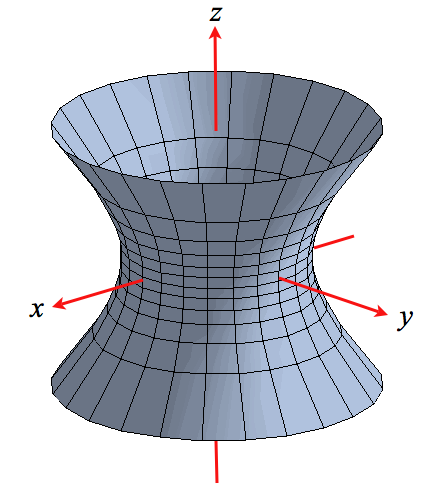
$$x^2+y^2 - z^2 \,=\, 1$$
Single-sheeted Hyperboloid
| Level surfaces: For a function $w=f(x,\,y,\,z) :\, U \,\subseteq\, {\mathbb R}^3 \to {\mathbb R}$ the level surface of value $c$ is the surface $S$ in $U \subseteq {\mathbb R}^3 $ on which $f\Bigl|_{S} = c\, $. |
Example 1: The graph of $z=f(x,\,y)$ as a surface in $3$-space can be regarded as the level surface $w = 0$ of the function $w(x,\,y,\,z) = z - f(x,\, y)$.
Example 2: Spheres $x^2+y^2+z^2 = r^2$ can be interpreted as level surfaces $w = r^2$ of the function $w = x^2+y^2+z^2$. Can you see how to interpret ellipsoids in the same way?
From the earlier example of $ w = f(x,\,y,\, z) = x^2 + y^2 - z^2$. we obtain three particularly important surfaces as level surfaces:
|
|
|
|
Recognize the curves of intersection? There must be some underlying mathematical theory! To do no more than hint at what that theory might be notice
 all the surfaces have been the graph of some quadratic
relation in $x,\, y,$ and $z$ like $z - x^2 + y^2 = 0$ in the case
of a hyperbolic paraboloid or $x^2 + y^2 + z^2 = r^2$ for a
sphere,
all the surfaces have been the graph of some quadratic
relation in $x,\, y,$ and $z$ like $z - x^2 + y^2 = 0$ in the case
of a hyperbolic paraboloid or $x^2 + y^2 + z^2 = r^2$ for a
sphere,
all the cross-sections of these surfaces have been
conic sections like parabolas, hyperbolas etc.
In view of the first of these comments we make the following
| Definition: a surface $S$ in $3$-space is said to a Quadric Surface when it is the graph of a quadratic relation in $x,\, y,\, $ and $z$. In particular, all the surfaces described so far are Quadric Surfaces. |
|
|
|
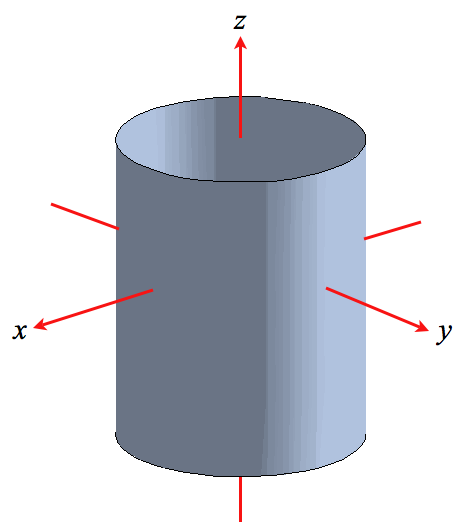
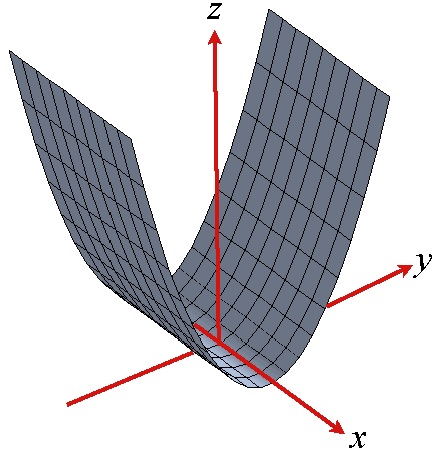
Do you see that the circular cylinder to the left is the graph in $3$-space of $x^2+ y^2 = r^2$ for fixed $r$ because every horizontal slice is the same circle of radius $r$? Similarly, the cylinder to the right is parabolic; it's the graph of, say, $z = y^2$, since the intersection with every vertical plane $x = a$ is the same parabola $ z = y^2$, say. Not surprisingly, it's called a Parabolic cylinder.