|
|
|
|
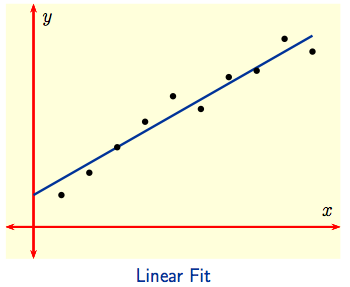
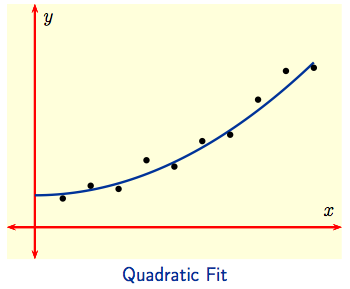
The minimum value of the sum
$$E(m,\,b) \ = \ (p_1 - y_1)^2 + (p_2 - y_2)^2 + \ldots + (p_n - y_n)^2\qquad \qquad \qquad \qquad\qquad$$
$$\qquad \qquad \qquad \ = \ ( mx_1 + b - y_1)^2 + ( mx_2 + b - y_2)^2 + \ldots + ( mx_n + b - y_n)^2$$
as $m,\ b$ vary is called the Least Squares Error.
For the minimizing values of $m$ and $b$, the corresponding line $y = mx + b$ is called the Least Squares Line or the Regression Line. |
As an illustration of the surface area formula, let's prove another remarkable result of Archimedes - obtained, remember, over 1,600 years before calculus was invented!
|
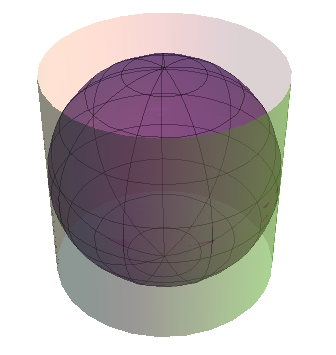
Recall first some known results: But if the cylinder exactly circumscribes the sphere as shown to the right, i.e, the cylinder and the sphere have the same radius and height, then $h = 2R$. In this case, both the sphere and circumscribing cylinder have equal surface area $4\pi R^2$. Even though this result is clear on the basis of computation, does it seem obvious geometrically? |
|
|
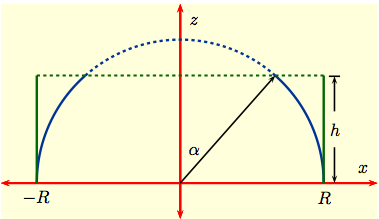
Problem: do the blue capped sphere and the
exactly circumscribing green cylinder always have equal surface area?
Solution: the surface area of the cylinder is easy to determine - it's just $2\pi R h$ when the topped sphere has radius $R$ and height $h$. Determining the surface area of the topped sphere, however, needs the surface area integral formula: parametrize the sphere by $${\mathbf\Phi} (\theta, \, \phi) = R \cos \theta \sin \phi \, {\bf i} + R \sin \theta \sin \phi \, {\bf j} + R \cos \phi\, {\bf k}\,.$$ The scalar surface element is then $$ \left\|\frac{\partial {\mathbf\Phi}}{\partial \theta} \times \frac{\partial {\mathbf\Phi}}{\partial \phi}\right\|\,d\theta d \phi\ = \ R^2 \sin \phi\, d\theta d \phi\,.$$ Now slice the sphere by the equatorial plane and a horizontal plane of height $h$ above this equatorial plane. To use the surface area integral we need to determine the limits of integration. |
| The portion of the upper hemisphere centered at the origin of radius $R$ cut off by the plane $z = h$ is shown in cross-section to the right. Its $$\hbox{surface area} = R^2 \int_0^{2\pi}\Big(\int_{\alpha}^{\pi/2} \sin \phi\, d\phi \Big)d\theta$$ $$\qquad = \ 2\pi R^2 \cos \alpha \ = \ 2\pi R h\,,$$ which is exactly the same as the surface area of the circumscribing cylinder of radius $R$ and height $h$!! |
|
| Definition: the surface integral of a scalar valued continuous function $z = f(x,\,y,\,z)$ over a surface $S$ parametrized by ${\mathbf \Phi} : D \,\subseteq \, {\mathbb R}^2 \to {\mathbb R}^3$ is given by $$\int\int_S \ f\, dS \ = \ \int\int_{D}\ f\big({\mathbf \Phi} (u,\,v)\big)\, \left \|\frac{\partial {\mathbf \Phi}}{\partial u} \times \frac{\partial {\mathbf \Phi}}{\partial v}\right \|\, du dv\,.$$ |
|
Example 1: evaluate the integral
$$ I \ = \ \int\int_S \ 2xyz \, dS$$
when $S$ is the part of the plane
$$ 2z \ = \ 2 - x +2y\,,$$
above the rectangle $[0,\,1] \times [0,\,1]$ in the $xy$-plane.
Solution: the surface area element for the plane $$z \ = \ 1 - \frac{x}{2} +y$$ is given by $$dS \ = \ \sqrt{z_x^2 + z_y^2 + 1} \ = \ \sqrt{\frac{1}{4} + 1 + 1} \ = \ \frac{3}{2}\,.$$ |
On the other hand, on $S$, $$2xyz \ = \ 2xy\left(1 - \frac{x}{2} +y\right) \qquad \qquad $$ $$\qquad \qquad = \ 2xy - x^2y + 2xy^2\,.$$ Thus $$I \ = \ \frac{3}{2} \int_0^1\left(\int_0^1\, (2xy - x^2y + 2xy^2)dy\right)dx$$ $$= \ \frac{3}{2} \int_0^1\, \left(x - \frac{1}{2}x^2 + \frac{2}{3}x\right)\, dx\,. $$ Consequently, $$I \ = \ \frac{3}{2}\left(\frac{1}{2} - \frac{1}{6} +\frac{1}{3}\right) \ = \ 1\,.$$ |
|
Example 2: use the fact that a sphere of radius $R$ is created by rotating the graph of
$$ z \ = \ \sqrt{R^2 - x^2}\,, \quad |x| \le R\,,$$
about the $x$-axis to determine the surface area of a sphere of radius $R$.
Solution: when $z = \sqrt{R^2 - x^2}$ is rotated about the $x$-axis, |
$$dS = \sqrt{R^2 - x^2} \left( 1 + \left(\frac{x}{\sqrt{R^2 - x^2}}\right)^2\right)^{1/2}dx d\psi.$$ After simplification, this becomes $dS = R\,dxd\psi$. Thus a sphere of radius $R$ has $$\hbox{surface area} \ = \ \int_0^{2 \pi}\int_{-R}^R\, R\,dxd\psi\ = \ 4\pi R^2\,.$$ |
| Recall: $$\int\, \sec^3u\, du \ = \ \frac{1}{2} \left (\ln \left| \sec u + \tan u\right| + \sec u \tan u \right) + C$$ |
 the surface area of a
sphere of radius $R$ is $4\pi R^2$,
the surface area of a
sphere of radius $R$ is $4\pi R^2$,