Inverse Trig Functions
Sine, Cosine, and Tangent
The functions sine, cosine and tangent are not one-to-one, since
they repeat (the first two every $2\pi$, the latter every $\pi$). To get inverse functions, we must
restrict their domains. We could do this in many ways, but the convention is:
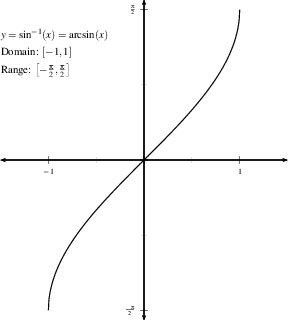
- For sine, we restrict the domain to $[-\pi/2, \pi/2]$. By definition, $\sin^{-1}(x)$
is the angle between $-\pi/2$ and $\pi/2$ whose sine is $x$. This only
makes sense if $-1 \le x \le 1$. In other words,
|
$$\theta =
\sin^{-1}(x) \quad \Longleftrightarrow \quad \sin(\theta)=x, \quad \hbox{ for }-\pi/2 \le \theta \le \pi/2.$$
|
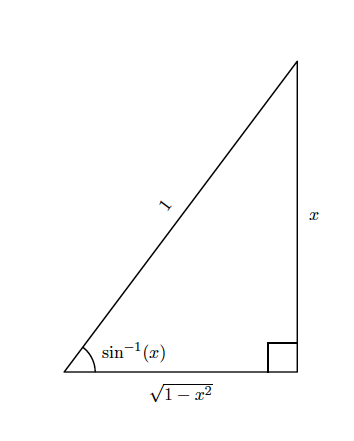
The best way to understand
$\sin^{-1}(x)$ is to draw a right triangle with sides of length $x$
and $\sqrt{1-x^2}$ and hypotenuse of length $1$.
-
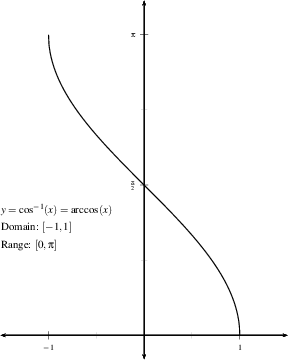
For cosine, we restrict the domain to $[0,\pi]$. By definition, $\cos^{-1}(x)$ is the
angle between $-\pi/2$ and $\pi/2$ whose cosine is $x$. So,
|
$$\theta =
\cos^{-1}(x) \quad \Longleftrightarrow \quad \cos(\theta)=x, \quad \hbox{ for }0 \le \theta \le \pi.$$
|

-
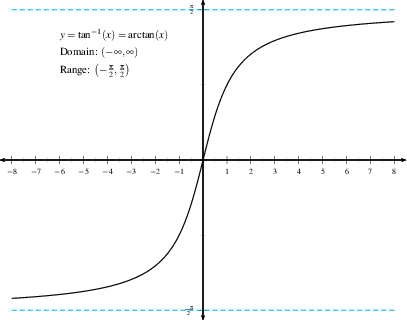
For tangent, we restrict the domain to $(-\pi/2, \pi/2)$.
|
$$\theta=\tan^{-1}(x) \quad \Longleftrightarrow \quad
\tan(\theta)=x, \quad \hbox{ for } -\pi/2 < \theta < \pi/2.$$
|
This is defined
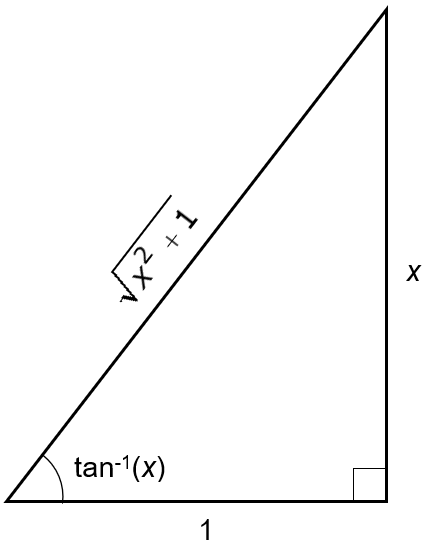
for all real values of $x$. To understand $\tan^{-1}(x)$, draw a right
triangle where the legs have length $x$ and $1$ and the hypotenuse has
length $\sqrt{1+x^2}$.
Other Trig Functions
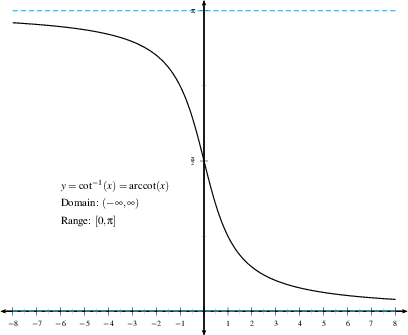
Since $\cot(\theta)=1/\tan(\theta)$, $\cot^{-1}(x)=\tan^{-1}(1/x)$.
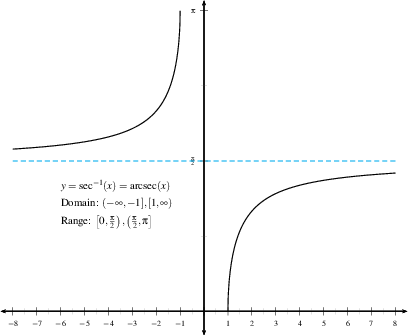
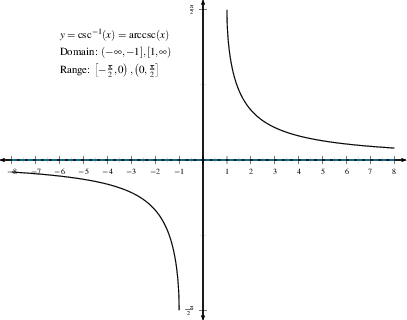
Likewise, $\sec^{-1}(x)=\cos^{-1}(1/x)$ and $\csc^{-1}(x)=\sin^{-1}(1/x)$. So, they can be derived from the inverse functions defined above.
Some Facts:
-
The function $\cos^{-1}$ is closely related to
$\sin^{-1}$. Specifically, $\cos^{-1}(x) =
\frac{\pi}{2}-\sin^{-1}(x)$. This is because
$\cos\left(\frac{\pi}{2}-\theta\right)=\sin(\theta)$.
-
In practice, $\sin^{-1}$ and $\tan^{-1}$ come up a lot, $\cos^{-1}$
and $\sec^{-1}$ come up occasionally, while $\cot^{-1}$ and
$\csc^{-1}$ almost never come up.
-
Another name for $\sin^{-1}(x)$ is $\arcsin(x)$. (But watch out: Some
authors use $\arcsin(x)$ to mean any angle whose sine is $x$, not just
the angle between $-\pi/2$ and $\pi/2$.) Likewise, $\arctan(x)$ and
$\arccos(x)$ mean $\tan^{-1}(x)$ and $\cos^{-1}(x)$.
-
The notation $\sin^{-1}(x)$ should not be confused with expressions
like $\sin^2(x)$. $\sin^2(x)$ is shorthand for $(\sin(x))^2$, but
$\sin^{-1}(x)$ is not $\sin(x)^{-1}$. It is the inverse sine of
$x$. The same applies to $\cos^{-1}(x)$ and $\tan^{-1}(x)$. These are
inverse functions, not reciprocals!