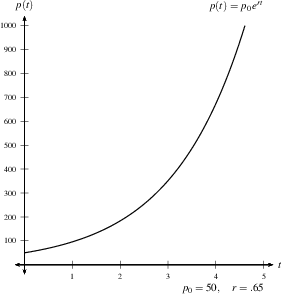
The population of a colony of plants, or animals, or bacteria, or humans, is often described by an equation involving a rate of change (this is called a "differential equation"). For instance, if there is plenty of food and there are no predators, the population will grow in proportion to how many are already there: $$ \frac{d p}{dt} = r p,$$ where $r$ is a constant. It's not hard to check that the function $p(t) = p_0 e^{rt}$
satisfies this differential equation, where $p_0$ is the starting population. Colonies tend to grow exponentially until they run out of space or food or run into predators.
When there are limits on the food supply, the population is often governed by the logistic equation: $$ \frac{dp}{dt} = c p (L-p),$$ where $c$ and $L$ are constants. The population grows exponentially for a while, and then levels off at a horizontal asymptote of $L$.
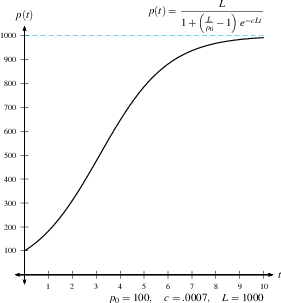
The logistic equation also governs the growth of epidemics, as well as, for example, the frequency of certain genes in a population.