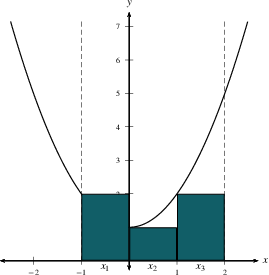
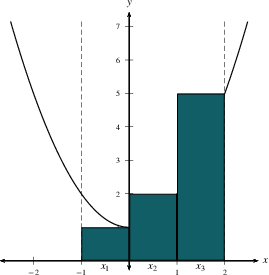
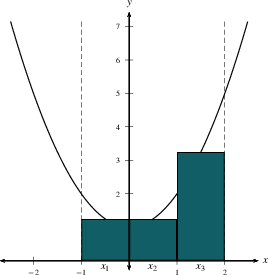
Riemann Sums Notation

The total area under $y=f(x)$ on an interval is approximated by $$\sum_{i=1}^n \,f(x_i^*)\, \Delta x,$$ which is the sum of the areas of $n$ rectangles.

This sort of expression is called a Riemann Sum
We use the Greek letter sigma ($\Sigma$) to mean "sum". The expression "$\displaystyle{\sum_{i=1}^n (\hbox{formula involving $i$})}$" means

"plug $i=1$ into the formula, then plug in $i=2$, all the way up to $i=n$, and add up the terms."

The notation for Riemann Sums can be complicated. Keep referring to the left side for a list of symbols.


Notation:
  • $a$ is the starting point;
    $b$ is the end point.
  • $n$ is the number of pieces in which the interval $[a,b]$ is subdivided.
  • $\Delta x = \displaystyle{\frac{b-a}{n}}$ is the size of each of those sub-intervals.
  • $[x_{i-1}, x_i]$ is the $i$th interval; in particular $x_0=a$, $x_1=a+\Delta x$, $\ldots$, $x_i=a+i\Delta x$, $x_n=b$.
  • $x_i^*$ is a representative from the $i$th interval
  • $f(x_i^*)$ is the height of the rectangle $R_i$ over the $i$th interval.
  • $f(x_i^*) \Delta x$ is the area of $R_i$.


The exact area is the limit of the Riemann sum as $n \to \infty$. Notice that we could use the left endpoint $x_{i-1}$, the right endpoint $x_i$, the midpoint $\frac{x_{i-1}+x_i}{2}$, or any other representative point.


While each choice will give us different approximations, they will all give us the same answer at the limit!