Warning: when we say a
limit $=\infty$, technically the limit doesn't exist.
$\displaystyle\lim_{x\to a}f(x)=L$ makes sense (technically) only
if $L$ is a number. $\infty$ is not a number! (The
word "infinity" literally means without
end.) If the limit is $+ \infty$, then the
function increases without end. If the limit is $-\infty$, it
decreases without end. We say a limit is equal to
$\pm\infty$ just to indicate this increase or decrease, which is
more information than we would get if we simply said the limit
doesn't exist.
|
Definition: The line $x=a$ is a vertical
asymptote of a function $f$ if the limit of
$f$ as $x\to a$ from the left and/or right is
$\pm\infty$. This means at least one of the
following is true:
|
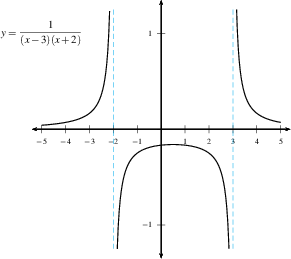
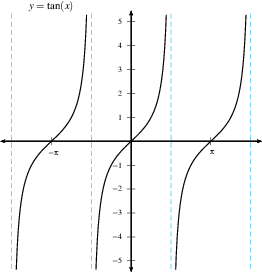
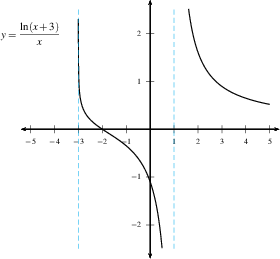
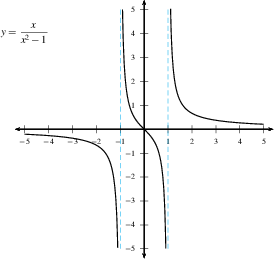
Here are some examples of graphs with one or more vertical
asymptotes.
DO: Find all vertical asymptotes in the
following graphs.