Process for finding intervals of increase/decrease

  1. If possible, factor $f'$.  If $f'$ is a quotient, factor the numerator and denominator (separately).  This will help you find the sign of $f'$.

  2. Find all critical numbers $x=c$ of $f$.

  3. Draw a number line with tick marks at each critical number $c$.

  4. For each interval (in between the critical number tick marks) in which the function $f$ is defined, pick a number $b$, and use it to find the sign of the derivative $f'(b)$.

  5. If $f'(b) > 0$, draw a straight line slanting upward over that interval on your number line.  Similarly, if $f'(b) < 0$, draw a straight line slanting downward.

  6. That's it! You can now see the intervals where $f$ is increasing and decreasing.

Tips

DO:  For any $b$ in an interval as above, $f'(b)$ will never be 0, and $f'(b)$ will always be defined. Why?

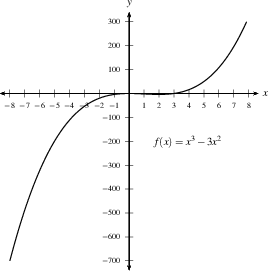
Example: Find where $f(x) = x^3 -3x^2$ is increasing/decreasing.
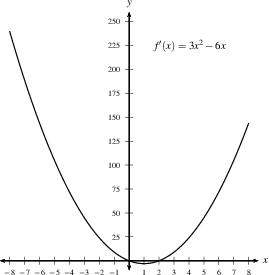
        Graph of $f$:                Graph of $f'$:       

DO:  Try to follow the process (above) to work this problem before looking at the solution below.


Solution:
  1. $f'(x)=3x^2-6x=3x(x-2)$

  2. Since $f'$ is always defined, the critical numbers occur only when $f'=0$, i.e., at $c=0$ and $c=2$.

  3. Our intervals are $(-\infty,0)$, $(0,2)$, and $(2,\infty)$.

  4. On the interval $(-\infty,0)$, pick $b=-1$.  (You could just as well pick $b=-10$ or $b=-0.37453$, or whatever, but $-1$ is simplest.)  Both factors are negative, so $f'(-1)$ is positive.  (You can also get this by just evaluating $f'(-1)=9$).  On the interval $(0,2)$, pick $b=1$.  One factor ($x$) is positive, while the other ($x-2$) is negative, so the product is negative.  Or just evaluate $f'(1)=-3$.  On the interval $(2,\infty)$, pick $b=3$. Both factors are positive, so $f'(3)$ is positive.  Note that all we need here is the sign of $f'$, not its value.

  5. So our function is increasing on $(-\infty,0)$, decreasing on $(0,2)$, and then increasing again on $(2,\infty)$.