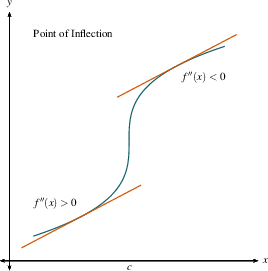
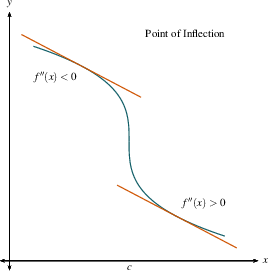
- If possible, factor $f''$. If $f''$ is a
quotient, factor the numerator and denominator
(separately).
- Find all critical numbers $x=s$ of $f'$.
These are the points where $(f')'=0$ or $(f')'$ doesn't
exist (i.e., the points where $f''=0$ or where $f''$
doesn't exist). You might want to call these $s$ subcritical
numbers.
- Draw a number line with tick marks at each
subcritical number $s$.
- For each interval between subcritical numbers in which
the function $f$ is defined, pick a number $b$, and then
find the sign of the second derivative $f''(b)$.
- If $f''(b) \gt 0$, then $f'$ is increasing on the
interval containing $b$. This means that the
slopes are increasing, so $f$ is concave up. Draw
a right-side-up bowl over that interval on your number
line. Similarly, if $f''(b) \lt 0$, draw an
upside-down bowl.
- That's it! You can now see the intervals where $f$ is
concave up or down.
|