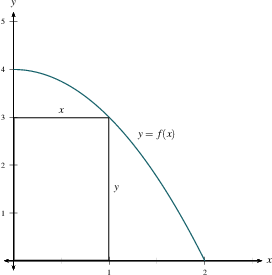
Solution: As shown in the video, our rectangle has width $x$ and height $y$, and so has area $xy$. But $y=4-x^2$, so our area is $$A(x)= x(4-x^2) = 4x-x^3.$$ This turns our word problem into just finding the maximum value of $A(x)$ on $[0,2]$. Since $A'(x)=4-3x^2$, we have a critical number when $4-3x^2=0$, or $x = \frac{2}{\sqrt{3}}$. Then $y= 4-x^2 = 4 - \frac{4}{3} = \frac{8}{3}$, and the area is $$A = xy = \frac{16}{3\sqrt{3}} = \frac{16 \sqrt{3}}{9}.$$
(The video cuts out a few seconds too soon, but the end
of the calculation is shown to the left.)