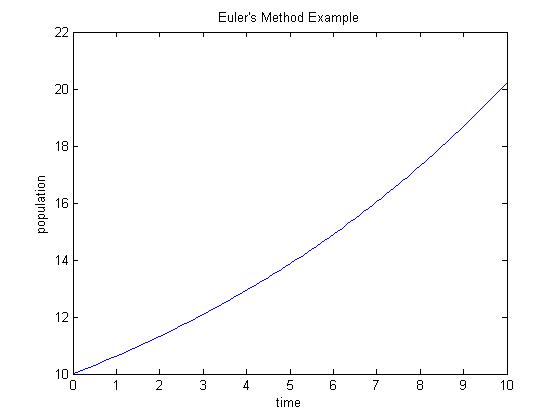
Suppose that $y(t)$ represents the amount of seaweed growing in a patch of ocean. Left to itself, the seaweed would grow exponentially, with a growth rate $r$, but we are also harvesting seaweed at a rate $h$. (Here "h" stands for "harvest", and is not the same as the time step, which we're calling $\Delta t$!) We then have the following simple model for the rate at which the amount of seaweed is changing: $$ y'=ry-h,\qquad y(0)=y_0.$$ We can use Euler's Method to find an approximate solution to this IVP.
The Matlab m-file, Eulers.m (located on the MATLAB course webpage), can be used to answer the following questions. Directions for using this m-file are available in the Matlab 408R User Manual (also available on the course webpage). Once you have downloaded the m-file Eulers.m, opened it in your MATLAB m-file editor and saved it to the working directory, go to the Command Window and enter:
Eulers(10,100,.1,.2,10);
This command passes the following parameters to the m-file Eulers; tmax = 10, N = 100, $r=0.1$, $h=0.2$, and $y_0=10$. Here, [0, tmax] is the time interval used and $N$ is the number of time steps used (so $\Delta t$ = tmax/N). Once you have entered your command and pressed enter, you should get something like the following plot:
Don't just read about it here. Do it!! It is extremely important that you get a feel for how MATLAB operates, and there is no substitute for running it yourself.
Try changing some of the parameters to different values. What happens? (You'll be asked more about this in a subsequent slide.)