Differentiability


Definition: A function $f$ is said to be differentiable at $x=a$ if and only if $$f'(a)=\lim_{h \to 0} \frac{f(a+h)-f(a)}{h}$$ exists.  A function $f$ is said to be differentiable on an interval $I$ if $f'(a)$ exists for every point $a \in I$.


Differentiability and Continuity

Theorem: If a function is differentiable at $a$, then it is also continuous at $a$.

However, it can be continuous without being differentiable!


How can a function fail to be differentiable?

There are several ways that a function can fail to be differentiable. In particular:

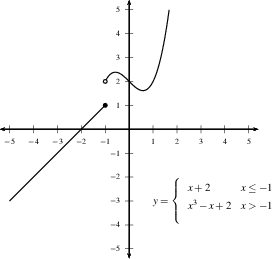
  • The function may have a discontinuity, e.g., the function below at $x=-1$
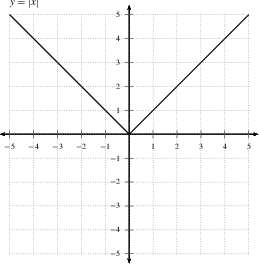
  • The function may have a sharp change in direction, e.g., $f(x) = |x|$ at $x=0$.
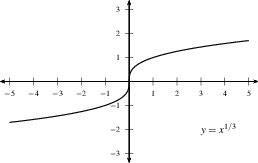
  • The function may have a vertical tangent, e.g., $f(x) = x^{1/3}$ at $x=0$.