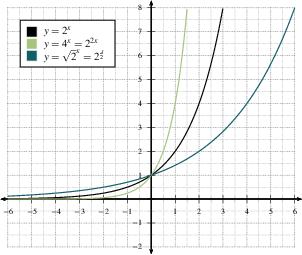
The function $f(x)=a^x$ is defined for all $x$ whenever $a >
0$. Here are some features of its graph:
If $a > 1$, this function grows very quickly to the right
and shrinks very quickly to the left. Exponential growth is fast.
Different values of $a >1$ give essentially the
same graph, only stretched horizontally. For instance,
since $4^x=(2^2)^x=2^{2x}$, the graph $y=4^x$ is just
like $y=2^x$, only shrunk horizontally. Similarly,
since $(\sqrt{2})^x = 2^{x/2}$, the graph
$y=(\sqrt2)^x$ is like $y=2^x$, only stretched.
DO:
Plug
in some values of $x$ into $f(x)=2^x$, such as
$x=-2,-1,0,1,2,5,10$ to see why the graph looks like the sketch
above.
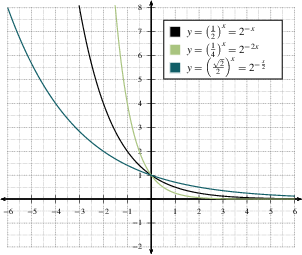
If $a < 1$, then the function shrinks quickly to the right
and grows quickly to the left. After all, $a^x=(a^{-1})^{-x}$.
DO: Plug in
some values of $x$ into $f(x)=(\frac{1}{2})^x$, such as
$x=-2,-1,0,1,2,5,10$ to see why the graph looks like the sketch
above.
If $a=1$, then the function $f(x)=1^x=1$ is constant.
The graph $y=a^x$ always goes through $(0,1)$, no matter what
$a$ is. DO:
Why is this?
The domain of the function $a^x$ is the whole real
line.
The range of the function $a^x$ is $(0,\infty)$
(unless $a=1$). This means that $a^x>0$ for all $x$. DO: Why is this?
DO: Play
with shifting and otherwise transforming the graph of
$f(x)=2^x$.
For example, graph $2^{x+3}$ and $2^{x-1}$ and
$-2^x$ and $2^x-5$, etc. You will need this practice for the
questions that come later in this learning module. You
may need to refer to some precalculus material to recall how to
do such transformations.
You
will need to be very comfortable with transforming
functions in this course.