Examples 1, 2:
In the following video we integrate
Pics |
|
Example 3: Evaluate the integral
$$I \ = \ \int \int_D\, (x+y)\, dA$$
when $D$ consists of all points $(x,\,y)$ such that
$$0 \ \le \ y \ \le \sqrt{9-x^2}\,, \quad 0\ \le \ x \ \le 3\,.$$
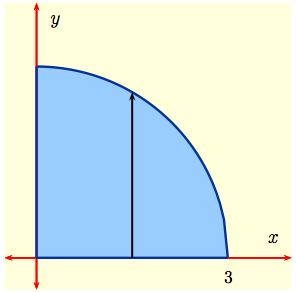
Solution: Since $y^2 \ = \ 9 - x^2$ is a circle of radius $3$ centered at the origin, $D$ consists of all points in the first quadrant inside this circle as shown below. This is a Type I region, which suggests
|
In Example 3 algebraic conditions specifying $D$ suggested how to write the integral as a repeated integral. Other times algebraic conditions are best interpreted graphically before deciding on limits of integration.
|
Example 4: Evaluate the integral
$$I \ = \ \int \int_D\, (3x +4y)\, dA$$
when $D$ is the bounded region enclosed by $y = x$ and $y=x^2$.
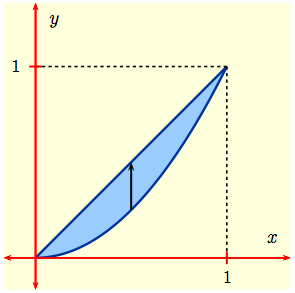
Here $D$ is enclosed by the straight line $y = x$ and the parabola $y = x^2$ as shown below. To determine the limits of integration we first need to find the points of intersection of $y = x$ and $y = x^2$. These occur when $x^2 = x$, i.e., when $x = 0,\, 1$. Treating $D$ as a Type I region, we fix $x$ and integrate with respect to $y$ along the black vertical line, getting the repeated integral $$ I \ = \ \int_0^1\left(\int_{x^2}^{x}\, (3x + 4y)\, dy\right)\,dx$$
|
In Example 4 it was simpler to fix $x$ and integrate first with respect to $y$ because the bounding curves were already given to us as $$y \ = \ f_1(x)\ = \ x^2\,,\qquad y \ = \ f_2(x)\ = \ x\,.$$ Had they been given as $x \,=\, g_1(y)$ and $x\,=\, g_2(y)\,$ it might have been easier to think of $D$ as a Type II region. We would fix $y$ and first integrate with respect to $x$.
|
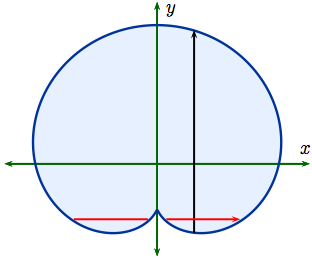
Example 5: The region $D$ that is shown below is Type I but
is not Type II. Fixing $x$ and integrating first with respect to $y$
along the black line makes good sense because then
$$ D \ = \ \Bigl\{\,(x,\,y) : \phi(x) \le y \le \psi(x),\ \ a \le x \le b\,\Bigl\}$$
for suitable choices of $a,\, b$ and functions $\phi(x),\, \psi(x)$:
$$ \int \int_D\, f(x,\,y)\, dxdy
= \int_a^b \left(\int_{\phi(x)}^{\psi(x)}\, f(x,\,y)\, dy\right) dx\,.$$
But if we had chosen to fix $y$, then the integral with respect to
$x$ would sometimes split into two parts shown in red. Not a good idea!
|
|
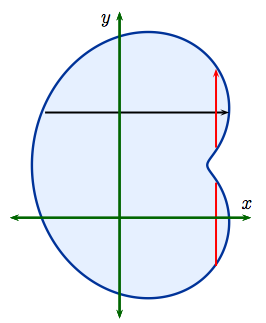
Example 6: The region $D$, shown below, is Type II but
not Type I. Fixing $y$ and integrating first with respect to $x$ along
the black line makes good sense because then $$ D \ = \
\Bigl\{\,(x,\,y) : \phi(y) \le x \le \psi(y),\ \ c \le y \le
d\,\Bigl\}$$ for suitable choices of $c,\, d$ and functions
$\phi(y),\, \psi(y)$. In this case
$$ \int \int_D\, f(x,\,y)\, dxdy
= \int_c^d \left(\int_{\phi(y)}^{\psi(y)}\, f(x,\,y)\, dx\right) dy\,.$$
But if we had chosen to fix $x$, then the integral with respect to
$y$ would sometimes splits into two parts as shown in red. Again not a
good idea!
|