|
Regular $u$-substitution works by setting $u=g(x)$ for some function $g$. We have to pick $u$ so that the integrand becomes a nice function of $u$ times $du$. In the video, we explore inverse substitutions.
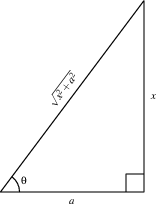
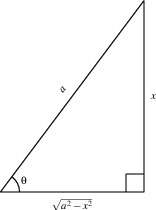
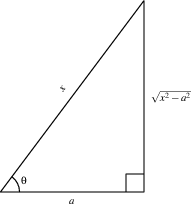
With inverse substitutions, we let $x = g(\theta)$, where typically $g$ is a trig function. Then $dx = g'(\theta)\, d\theta$, and we can always rewrite the integrand in terms of $\theta$ and $d\theta$. The tricky part is converting everything back to $x$ at the end of the problem.
There are three very useful trig substitution:
|