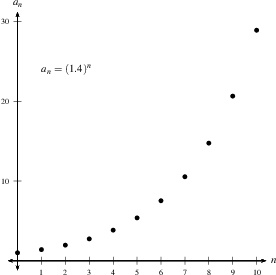
Consider the sequence
$\{a_n\}=\{a_n\}_{n=1}^\infty=a_1,a_2,a_3,\ldots$. Recall
that this sequence is graphed by letting the horizontal axis be
the $n$-axis, and $a_n$ the height of the dot. We look at
the graphs of a number of examples of (infinite) sequences
below. We can get a visual idea of what we mean by saying a
sequence converges or diverges. These examples are discussed
in the video that follows.
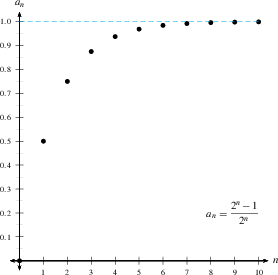
1) $\displaystyle\frac12, \, \frac34,\, \frac78,\, \frac{15}{16}, \, \frac{31}{32},\ldots$ converges to 1. |
|
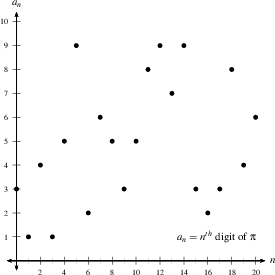
2) The digits of $\pi$, namely 3, 1, 4, 1, 5, 9, $\ldots$, diverge. |
|
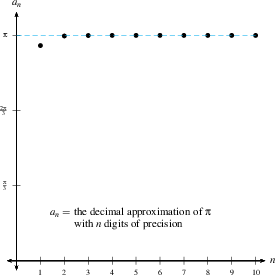
3) The decimal approximations of $\pi$, namely 3, 3.1, 3.14, 3.141, $\ldots$, converge to $\pi$. |
|
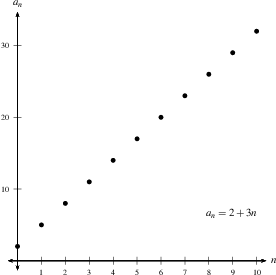
4) Arithmetic sequences, which are sequences where the difference between successive terms is constant ($(a_{n+1}-a_n)$ is constant), such as 2, 5, 8, 11, 14, $\ldots$, always diverge (unless the terms are all the same). |
|
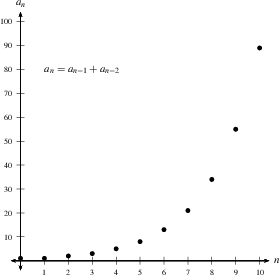
5) The Fibonacci sequence 1, 1, 2, 3, 5, 8, $\ldots$ diverges. |
|
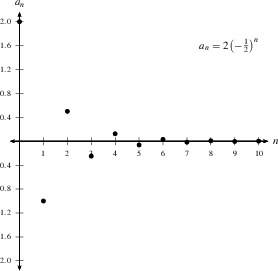
| 6) The sequence $\displaystyle 2, \, -1,\, \frac12,\, -\frac14,\,\frac18,\, -\frac{1}{16}, \ldots$ is an example of a geometric sequence (see below; here, $a=2$ and $r=-\tfrac 1 2$). This sequence converges to 0. |
|
| 7) Geometric
sequences are sequences where the ratio of successive terms is constant.
They look like$$\{ar^n\}_n= a,\,ar,\,ar^2,\,ar^3\ldots$$with
the constant ratio $r$. A geometric sequence converges
if $-1<r\le1$ and diverges otherwise. (We can see
that if $r=1$, this sequence is the constant sequence,
$a,a,a,\ldots$, which converges to $a$.) |
|