The Geometry of Partial Derivatives

Slopes in three dimensions

At a point $P(a,b,z)=(a,\,b,\, f(a,\,b))$ on the graph of $z = f(x,\, y)$,
$\displaystyle\frac{\partial f}{\partial x}\Bigl|_{(a,\,b)}=f_x(a,b)$ represents the slope in the $x$-direction at $P$, and

$\displaystyle\frac{\partial f}{\partial y}\Bigl|_{(a,\,b)}=f_y(a,b)$ represents the slope in the $y$-direction at $P$.

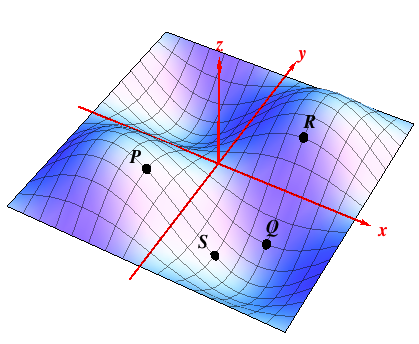
Example 1:  Consider the surface $z=f(x,y)$ to the right, and determine whether $f_x$ and $f_y$ are positive, negative, or zero at the points $P,\ Q, \ R,$ and $S$ on the surface. (Be aware of the placement of the axes.)

Solution 1: at $Q$, for instance, the surface slopes up for fixed $x$ as $y$ increases, so $f_y\bigl|_{Q} > 0$, while the surface seems to remain at a constant height at $Q$ in the $x$ direction for fixed $y$, so $f_x\bigl|_{Q}= 0$.  Considering the points $R$ and $P$, it appears that $$f_x\bigl|_{R} \,<\,0,\quad f_y\bigl|_{R} \,>\, 0\,, \qquad f_x\bigl|_{P} \,<\, 0,\, \quad f_y\bigl|_{P} \,=\, 0 \,.$$  DO: what happens at $S$? (answer at bottom of page)

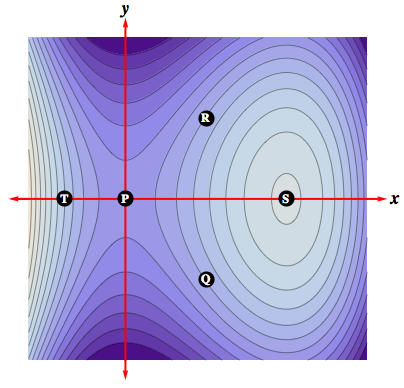
Information about the partial derivatives of a function $z = f(x,\,y)$ can be detected also from a contour map of $f$.  Indeed, as one knows from using contour maps to learn whether a path on a mountain is going up or down, or how steep it is, so the sign of the partial derivatives of $z = f(x,y)$ and relative size can be read off from the contour map of $f$.

Example 2: To the right is the contour map of the function $$z=f(x,y)= 3x^2 -y^2 -x^3 +2.$$ Here, the positive $z$ direction is coming toward you out of the page, with higher ground in lighter colors and lower ground in darker colors. Determine whether $f_x,\, f_y$ are positive, negative, or zero at $P,\, Q,\, R,\, S$, and $T$.  These are not the same points as before!

At $R$, for instance, are the contours increasing or decreasing as $y$ increases for fixed $x$?  That will indicate the sign of $f_y$. But what happens at $P$ or at $S$?

DO:  Determine the sign of these partial derivatives.
(answer at bottom of page)


Solution 1 (continued):  It appears that $\displaystyle f_x\bigl|_{S} \,<\,0,\quad f_y\bigl|_{S} \,=\, 0\,.$

-------------------------------------------------------------------------------

Solution 2:  It appears that $\quad f_x\big|_R>0,\quad f_y\big|_R<0,\quad f_x\big|_S=0,\quad f_y\big|_S=0, \quad f_x\big|_Q>0,\quad f_y\big|_Q=0,\quad$ $ f_x\big|_P=f_y\big|_P=0,\quad f_x\big|_T<0,\quad f_y\big|_T=0$

All the same ideas carry over in exactly the same way to functions $w = f(x,\,y,\,z)$ of three or more variables - just don't expect lots of pictures!! The partial derivative $f_z$, for instance, is simply the derivative of $f(x,\,y,\,z)$ with respect to $z$, keeping both of the variables $x$ and $y$ fixed.