Theorems for and Examples of Computing Limits of Sequences
Evaluating limits of sequences using limits of functions
The limit of a function is the limit of continuous values of the
function, while the limit of a sequence is a limit of discrete
numbers. Nonetheless, we recognize that if a continuous
function passes through all numbers of a sequence, then the
convergence or divergence of the sequence matches the convergence
or divergence of the function. To see this, just picture the
graph of a sequence (earlier in this module) and draw the curve
through the dots, letting the curve be $f(x)$, and hence
$f(n)=a_n$ for the positive integers $n$.
Theorem
1: Let $f$ be a function with $f(n)=a_n$ for
all integers $n>0$.
If $\displaystyle\lim_{x\to\infty}f(x)=L$, then
$\displaystyle\lim_{n\to\infty}a_n=L$ also.
|
This theorem allows use to compute
familiar limits of functions to get the limits of sequences.
Example 1: By the theorem, since
$\displaystyle\lim_{x\to\infty}\frac{1}{x^r}=0$ when $r>0$,
$\displaystyle\lim_{n\to\infty}\frac{1}{n^r}=0$ when
$r>0$. Learn this example.
-------------------------------------------------------------------
Example 2: Evaluate
$\displaystyle\lim_{n\to\infty}\frac{2n}{3n-4}$.
Solution 2: By dividing the top and the bottom by
$n$, we get $\displaystyle\lim_{n\to\infty}\frac{2}{3-\tfrac 4
n}$. By the previous example, $\tfrac 4 n$ converges to 0,
so we get
$\displaystyle\lim_{n\to\infty}\frac{2n}{3n-4}=\frac{2}{3}$.
-------------------------------------------------------------------
Example 3: Evaluate
$\displaystyle\lim_{n\to\infty}\frac{5n}{e^n}$. DO: To solve this limit, first
compute $\displaystyle\lim_{x\to\infty}\frac{5x}{e^x}$ before
reading on.
Solution 3: We use l'Hospital's Rule.
$\displaystyle\lim_{x\to\infty}\frac{5x}{e^x}\underset{\fbox{$\tfrac
\infty \infty\,,\,
\text{l'H}$}}{=}\lim_{x\to\infty}\frac{5}{e^x}=0$. Thus
$\displaystyle\lim_{n\to\infty}\frac{5n}{e^n}=0$ by Theorem 1.
Notice that we cannot take a derivative of a sequence, since a derivative exists only if the function is
continuous, and sequences are not continuous.
Yet, because of our theorem, we can use l'Hopital's rule on the
associated (continuous) $f(x)$ and compute our limit by taking
derivatives. We get the limit of
the sequence by evaluating the limit of the function.
Alternating sign sequences
Unlike continuous functions, sequences sometimes have alternating
positive and negative values, such as $a_n=\frac{(-1)^n}{n}$.
We cannot find a nice function $f$ with
$f(x)=\frac{(-1)^x}{x}$. (Why not?)
Fortunately, we have another theorem to help us with these
sequences.
Theorem 2: $\displaystyle
\lim_{n\to\infty}a_n=0$ if and only if
$\displaystyle\lim_{n\to\infty}|a_n|=0$.
Warning: This is
only true when the limits are equal to 0.
|
This theorem allows us to evaluate the limit of a sequence with both
positive and negative values by evaluating the limit of its absolute
value (using Theorem 1, for example). If this limit is 0, our
original limit is zero.
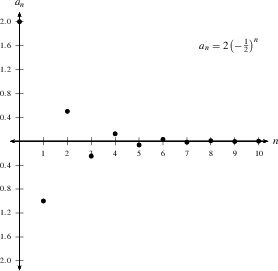
To see why this theorem makes sense, think about this graph
of a sequence $a_n=2\frac{(-1)^n}{2}$, which converges to
0. The graph of $\left\{|a_n|\right\}$ would flip all
the negative points to their positive values, giving a
sequence steadily decreasing to zero. |
|
Example 4: By Theorem 1, since
$\displaystyle\lim_{x\to\infty}r^x=0$ when $0<r<1$ (remember exponential functions?),
$\displaystyle\lim_{n\to\infty}r^n=0$ when $0<r<1$.
By Theorem 2, this extends to $-1<r<1$. If $r>1$
or $r\le-1$, the limit diverges. (DO:
what happens when $r=1$?) Summarizing:
$\displaystyle\lim_{n\to\infty}r^n
\left\{\begin{array}{ll}\text{converges }&\text{ if
}-1<r\le
1\\\text{diverges}&\text{otherwise}\end{array}\right.$
Learn this. We will use it
frequently.
-------------------------------------------------------------------
Example 5: Let $
a_n=(-1)^n\frac{3^{n+2}}{5^n}$. We will take the the
absolute value of our sequence, which here simply means ignoring
the alternating sign $(-1)^n$, and take a limit to see if we get
0. Rewrite to get
$|a_n|=3^2\left(\frac{3}{5}\right)^n=9\left(\frac{3}{5}\right)^n$.
We evaluate
$\displaystyle\lim_{n\to\infty}|a_n|=
\lim_{n\to\infty}\frac{3^{n+2}}{5^n}=9\left(\frac{3}{5}\right)^n=9\cdot
0=0$, by Example 4 with $r=\tfrac 3 5$, since
$-1<r<1$. Therefore,
$\displaystyle\lim_{n\to\infty}a_n=\lim_{n\to\infty}(-1)^n\frac{3^{n+2}}{5^n}=0$
by Theorem 2.