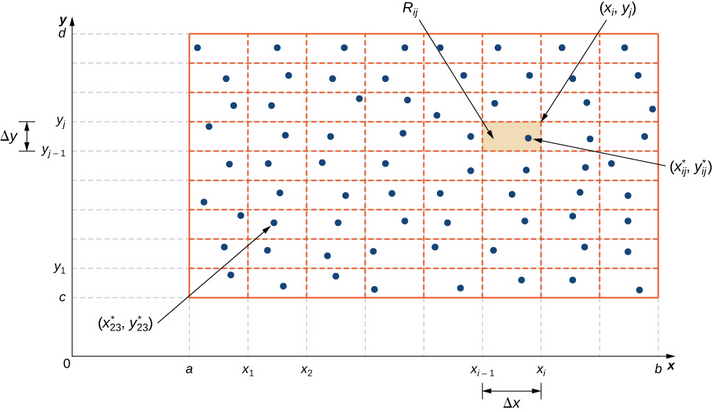
Break the interval $[a,b]$ into $m$ pieces, each of size $\Delta x = \frac{b-a}{m}$.
Break the interval $[c,d]$ into $n$ pieces, each of size $\Delta y = \frac{d-c}{n}$.
This breaks $R$ into smaller rectangular boxes, which we call $R_{ij}$, where $i$ indicates the column and $j$ indicates the row.
$R_{ij}$ has area $\Delta A =\Delta x\, \Delta y$.
For each pair $i,j$, pick a sample point $\left(x_{ij}^*, y_{ij}^*\right)$ somewhere in $R_{ij}$.
(For an approximation, a logical choice for the sample point $\left(x_{ij},y_{ij}\right)$ is given by the midpoint rule: $x_{ij}^* = a + \left(i-\frac12\right)\,\Delta x, \qquad y_{ij}^* = c+\left(j-\frac12\right)\Delta y.$)
cnx.or
Let the height of each tower over $R_{ij}$ be given by $f\left(x_{ij}^*,y_{ij}^*\right)$, i.e. by the height of the surface at our sample point over each rectangle.
Find the volume of each tower over each rectangle $R_{ij}$ as $f\left(x_{ij}^*,y_{ij}^*\right) \,\Delta A$.
Approximate the total volume by adding up all the tower volumes over all the $R_{ij}$, getting $$V\approx\displaystyle{\sum_{i=1}^m \sum_{j=1}^n f\left(x_{ij}^*, y_{ij}^*\right)\, \Delta A}.$$
www.stetson.edu
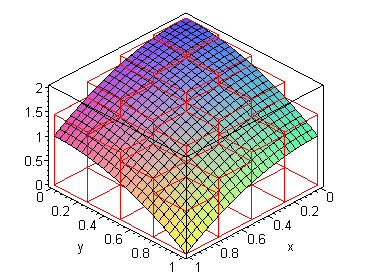
3-space, with the "floor" being the $xy$-plane
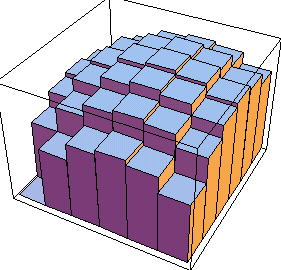
In this example, you can see both the rectangles $R_{ij}$ on the $xy$-plane, and above them the approximating columns, and the surface under which the volume is to be approximated.
www.stetson.edu