Some regions can be viewed as both Type I or Type II. In that case we can set up an iterated integral in two ways. Depending on the integrand, one can be a lot easier than the other.
Sometimes you're given an impossible-looking iterated integral,
and you can solve it by changing
the order of integration. Here are the steps
to change the order of integration.
|
Some examples are worked in detail in this video.
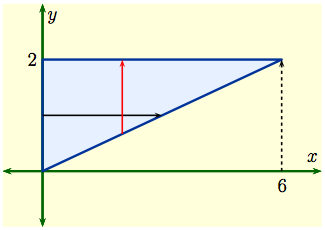
| Example 1: Evaluate the integral $$I \ = \iint_D\, x\,\sqrt{1+y^3}\, dA$$ when $D$ is the triangular region shown here, enclosed by the $y$-axis and the lines $$y \ = \ \frac{1}{3}x\,, \qquad y \ = \ 2\,.$$ |
|
Reversing the order of integration in a double integral requires creating a graph of the region of integration. Then it's a matter of algebra and inverse functions.
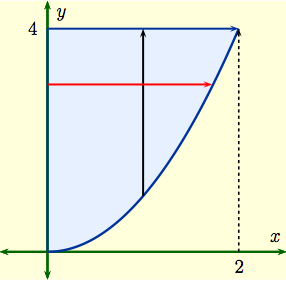
Solution 2: The region of integration is the set $$D \ = \ \Bigl\{\,(x,\,y) : \, x^2 \le y \le 4\,, \ \ 0 \le x \le 2\,\Bigr\}$$ which we determine from the limits of integration of $I$. The graph of $D$ is given to the right. The given iterated integral fixes $x$ and integrates with respect to $y$ along the vertical black line. To reverse the order of integration we need to fix $y$ and integrate with respect to $x$ along the red line. DO: Set up the new iterated integral before proceeding. |
|
The horizontal red line in graph of $D$ shows the lower limit of
integration is $x = 0$. The red line ends at the parabola $y
= x^2$, which can be written as a function of $y$ as $x =
\sqrt{y}$; this tells us the upper limit of integration $ x
=\sqrt{y}$. We also note that $y$ goes from $y=0$ to
$y=4$. Thus $D$ can also be written as $$D \ = \
\Bigl\{\,(x,\,y) : \, 0 \le x \le \sqrt{\,y }, \ \ 0 \le y \le
4\,\Bigr\}\,.$$ Rewriting $I$ after changing the order of
integration, we get $$I \ = \ \int _0^4\left(\int_0^{\sqrt{\,y}}\,
f(x,\,y)\, dx\right)\,dy\,.$$
| Warning: The tricky part of swapping the order of integration is rewriting the limits of integration. This involves studying the region of integration. $$\int_a^b \int_{y=g(x)}^{h(x)}\, f(x,y) \,dy\, dx$$ does NOT become $$\int_{g(x)}^{h(x)} \,\int_a^b f(x,y) \,dx\, dy \hbox{ !!}$$ |