The next simplest case is when the rate of change
$\frac{dy}{dx}$ can be factored in a way that separates the
dependance of $x$ and $y$. In particular,
A differential
equation is called separable if it's of the form
$$\frac{dy}{dx}=f(x)g(y).$$
If $g\ne 0$, we can cross-multiply to get $$\frac{dy}{g(y)} =
f(x)\, dx$$ and then integrate both sides. This yields $$G(y) =
F(x) + C,$$ where $F$ and $G$ are anti-derivatives of $f$ and
$1/g$, respectively. As always, we need to plug in the value of
one point to determine $C$.
Example: Find the
solutions of $$ \frac{dy}{dx}=xy^2+x.$$
Solution: The equation is separable, since the rate
of change $\frac{dy}{dx}$ can be written as
$f(x)g(y)=x(y^2+1)$. Notice that $y^2+1\ne0$. Hence, $$
\frac{dy}{y^2+1}=x\,dx $$ We integrate both sides $$
\int\frac{dy}{y^2+1}=\int x\,dx $$ to get $$
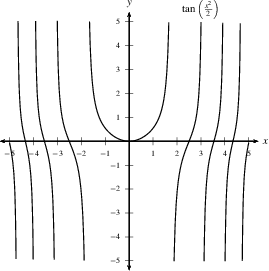
\arctan(y)=\frac{x^2}{2}+C, $$ or, $$
y=\tan\left(\frac{x^2}{2}+C\right). $$