Kepler's laws say that planets follow elliptical orbits around the sun, with the sun at a focus. In other words, the distance $r$ between a planet and the sun is given by $$r = \frac{ed}{1-e\cos(\theta-\theta_0)}.$$
| Perihelion and Aphelion: The point $\theta=\theta_0+\pi$ where the planet is closest to the sun is called perihelion, and is at distance $\displaystyle{r = \frac{ed}{1+e}}$. The point $\theta=\theta_0$ where the planet is farthest from the sun is called aphelion, and is at distance $\displaystyle{r=\frac{ed}{1-e}}$. (The terms perihelion and aphelion come from the Greek word helios, meaning sun, and are only applied to orbits around the sun.) |
Most planets have very low eccentricity, and their orbits are almost circles. The earth's eccentricity is only 0.0167, or 1.67%, so the distance to the sun at aphelion (around July 4) is about 3.3% farther than at perihelion (around January 3). As a result, the earth receives about 6.5% more sunlight in January than in July! [Note: seasons are caused by the tilt of the earth's axis, not by the eccentricity of the orbit.]
|
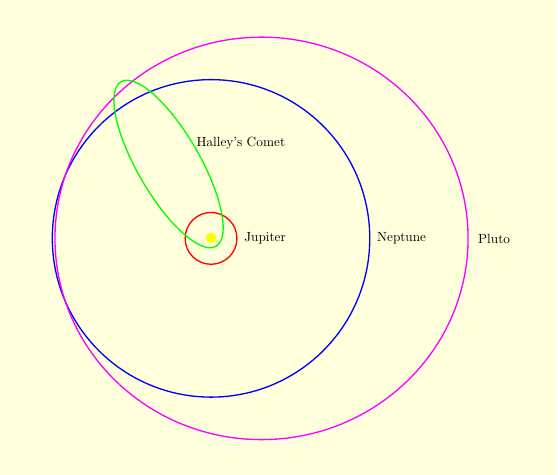
A few planets are a bit more eccentric. Mercury's eccentricity is about .2056. Pluto, no longer considered a planet, has an eccentricity of .248. At perihelion, Pluto is closer to the sun than Neptune. At aphelion, it is 60% farther. Comets have very high eccentricity, close to 1. They start very far from the sun, plunge into the solar system, make a close pass, and then zip out again. Halley's Comet has an eccentricity of .967, meaning that at aphelion it is $\displaystyle{\frac{1+e}{1-e}\approx 60}$ times farther from the sun than at perihelion. Comet Hale-Bopp, the brightest comet ever seen when it passed the sun in 1997, had an eccentricity of .995. Its aphelion is about 400 times farther than its perihelion. Occasionally, a comet will get a gravitational kick from a planet as it enters the solar system. This extra energy gives it an eccentricity slightly greater than 1. Comet C/1980 E1 had an eccentricity of 1.057. It followed a hyperbolic trajectory out of the solar system, and will never return. |
|