Among the top uses of the 2-dimensional change-of-variable formula are
The following video demonstrates ways to use the change-of-variable formula to simplify integrals. In it, we compute the integral of $e^{x+2y}$ over a parallelogram using a linear transformation, and the integral of $x^2$ over an off-center ellipse using a rescaling and a shift. Linear transformations also appear in examples 2a and 2b, below.
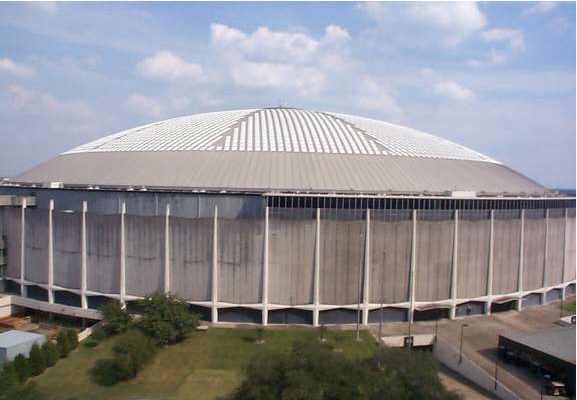
Example 1: Let's illustrate this change of variable idea in the case of polar coordinates. The Astrodome in Houston as shown to the right below might be modelled mathematically as the region below the cap of a sphere
| $$ x^2+y^2+z^2 \ = \ R^2$$ above a circular disk $$ D = \{(x,\,y) : x^2 + y^2 \le a^2\}\,.$$ In terms of double integrals its $$ \hbox{Volume} \ = \ \int\int_D\, \sqrt{R^2 - x^2 - y^2}\, dx dy\,.$$ Rotational symmetry suggests changing to polar coordinates! |
|
| Solution: In polar coordinates, $$D \ = \ \bigl\{ (r,\, \theta) : 0 \le r \le a\,, \ 0 \le \theta \le 2 \pi\,\bigl\}$$ is a rectangle, while $$\sqrt{R^2 - x^2 - y^2} \ = \ \sqrt{R^2 - r^2(\cos^2 \theta +\sin^2 \theta)} \,.$$ So after changing to polar coordinates, $$ I\ = \ \int_0^a\Bigl(\,\int_0^{2 \pi}\, \sqrt{R^2 - r^2}\ d\theta \Bigr)\, r dr\,.$$ | The presence of the Jacobian (here the $r$-factor) makes this an easy iterated integral using the substitution $u = r^2$. For then $$I = \pi \int_0^a\, \sqrt{R^2 - u}\, du= \frac{2\pi}{3}\Bigl[\, -(R^2 - u)^{3/2}\,\Bigl]_0^a\,.$$ Consequently, the mathematical Astrodome has $$ \hbox{Volume}\ = \ \frac{2\pi}{3}\Bigl(\, R^{3} - (R^2 - a^2)^{3/2}\Bigr)\, .$$ |
The Astrodome problem showed how this works when ${\bf \Phi}$ is the change of coordinates from polar to Cartesian coordinates, but matrix mappings often help too. They usually come in two 'flavors' as indicated in
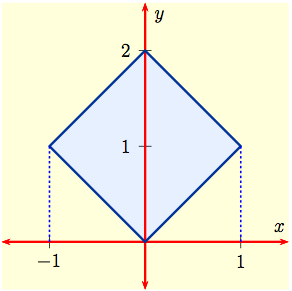
| Example 2a: Use the transformation $${\bf \Phi} : (u,\, v) \ \longrightarrow \ \bigl(\,x(u,\, v),\ y(u,\, v)\, \bigr)$$ with $$x \ = \ \frac{1}{2}\bigl(u-v\bigl) \,, \quad y \ = \ \frac{1}{2}\bigl(u+v\bigl) $$ to evaluate the integral $$ I \ = \ \int\int_D\ (x+y) \, dx dy$$ when $D$ is the square shown to the right. |
|
| Example 2b: Use an appropriate transformation $${\bf \Phi} : (u,\, v) \ \longrightarrow \ \bigl(\,x(u,\, v),\ y(u,\, v)\, \bigr)$$ to evaluate the integral $$ I \ = \ \int\int_D\ (x+y) \, dx dy$$ when $D$ is the square having corner points $$(0,\,0)\,, \ \ (1,\, 1)\,, \ \ (0,\, 2)\,, \ \ (-1,\, 1)\,.$$ as shown to the right. |
|
| Solution for Example 2a: When $$x \ = \ \frac{1}{2}\bigl(u-v\bigl) \,, \quad y \ = \ \frac{1}{2}\bigl(u+v\bigl) $$ the Jacobian of the transformation $${\bf \Phi} : (u,\, v) \ \longrightarrow \ \bigl(\,x(u,\, v),\ y(u,\, v)\, \bigr)$$ is given by $$\frac{\partial (x,\,y)}{\partial (u,\,v)} \ = \ \left|\begin{matrix} \displaystyle {\frac{1}{2}}& \displaystyle{-\frac{1}{2}}\cr \\ \displaystyle {\frac{1}{2}}& \displaystyle { \frac{1}{2}}\end{matrix}\right|\ = \ \frac{1}{2}\,.$$ On the other hand, $$x+y \ = \ \frac{1}{2}\bigl(u-v\bigl) + \frac{1}{2}\bigl(u+v\bigl)\ = \ u\,.$$ So if ${\bf \Phi}$ maps $D^*$ onto $D$, then $$I \ = \ \frac{1}{2}\int_a^b\int_c^d\ u\ du dv\,.$$ | It remains to find $a,\, b,\, c,\,d$ knowing that $${\bf \Phi}(a,\,c)\,=\, (0,\,0)\,, \quad {\bf \Phi}(b,\,c)\,=\, (1,\,1)$$ $${\bf \Phi}(b,\,d)\,=\, (0,\,2)\,, \quad {\bf \Phi}(a,\,d)\,=\, (-1,\,1)$$ But $x,\, y$ is given in terms of $u,\, v$: $$2x \ = \ u-v \,, \quad 2y \ = \ u+v\,, $$ so we need to solve for $u,\,v$: $$u\ = \ x+y \,, \qquad v\ = \ y-x\,.$$ This shows that $$a \,=\, c\,=\, 0, \quad b\,=\, 2, \quad d\,=\, 2\,,$$ Consequently, $$I \ = \ \frac{1}{2}\int_0^2\int_0^2\ u\, dudv\ = \ 2\, .$$ |
| Solution for Example 2b: Since we know the corners of $D$, we can use the point slope formula to express $D$ as the square enclosed by the pairs of parallel lines $$y=x,\ \ y= x+2, \quad y=-x,\ \ y=-x +2\,.$$ Thus $D$ is the region $$\big\{ (x,\,y) : 0 \le x+y \le 2,\ \ 0 \le y -x \le 2\big\}$$ in the $xy$-plane. This suggests setting $$ u \,=\, x+y,\quad v\,=\, y-x\,,$$ $$ D^* \ = \ \big\{ (u,\,v) : 0\le u \le 2,\ 0 \le v \le 2\big\}\,.$$ | To determine $${\bf \Phi} : (u,\, v) \to (x(u,\,v),\, v(u,\, v))$$ we need to express $x,\, y$ in terms of $u,\, v$. Solve for $x,\,y$ in the earlier linear equations: $$x \ = \ \frac{1}{2}\bigl(u-v\bigl) \,, \quad y \ = \ \frac{1}{2}\bigl(u+v\bigl) \,.$$ Consequently, after calculating the Jacobian as before we get $$I \ = \ \frac{1}{2}\int_0^2\int_0^2\ u\, dudv\ = \ 2\, .$$ |