Integrals over rectangles are
almost the same as integrals over intervals, except that now our
density $f(x,y)$ is the amount of stuff per unit area instead
of stuff per unit length. The simplest example of `stuff' is
volume, in which case $f(x,y)$ is height.
So suppose that $R = [a,b] \times [c,d]$ is a rectangle, where $x$ runs from $a$
to $b$ and $y$ runs from $c$ to $d$. Let's figure out the volume of the
solid between the $x$-$y$ plane and the surface $z=f(x,y)$, and over the
rectangle $R$.
Break the interval $[a,b]$ into $m$ pieces, each of size
$\Delta x = (b-a)/m$.
Break the interval $[c,d]$ into $n$ pieces, each of size
$\Delta y=(d-c)/n$.
Together, this breaks $R$ into $nm$ smaller rectangular boxes,
each of area $\Delta A =\Delta x \Delta y$. It breaks the solid
into little towers of width $\Delta x$, depth $\Delta y$, and
height $f(x,y)$.
Label the boxes with two indices $i,j$, where $i$ says what column
we're in and runs from 1 to $m$, while $j$ says what row we're in and
runs from 1 to $n$.
For each pair $i,j$, pick a sample point
$(x_{ij}^*, y_{ij}^*)$ somewhere in the $ij$-th box.
Approximate the volume of the tower over the $ij$-th box as
$f(x_{ij}^*,y_{ij}^*) \Delta A$.
Approximate the total volume as
$\displaystyle{\sum_{i=1}^m \sum_{j=1}^n f(x_{ij}^*, y_{ij}^*) \Delta A}$.
To get an exact answer, take a limit as $n \to \infty$ and
$m\to \infty$.
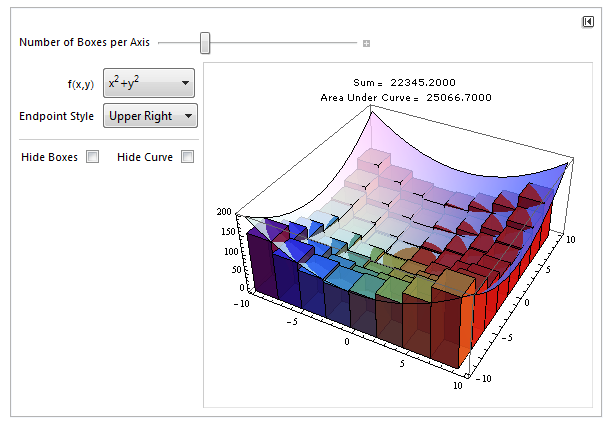
The figure to the right shows this process for the function
$f(x,y)=x^2+y^2$, where $R = [-10,10] \times [-10,10]$, and where
$n=m=8$. The volume under the surface is approximately the sum
of the volumes of a number of towers, and
the volume of each tower is $f(x_{ij}^*, y_{ij}^*) \Delta x \Delta y$.
As $n \to \infty$ and $m \to \infty$, the approximation gets better
and better, and in the limit gives the exact volume under the surface.
As with functions of one variable, the limit of this sum is the
definition of a (double) integral.
If $f(x,y)$ is a continuous function of two variables and if $R = [a,b]
\times [c,d]$ is a rectangle, then the double integral of $f$ over $R$
is
$$\iint_R f(x,y) dA = \iint_R f(x,y) dx dy = \lim_{m \to
\infty}\lim_{n\to\infty} \sum_{i=1}^m \sum_{j=1}^n f(x_{ij}^*,
y_{ij}^*) \Delta A.$$
A convenient choice for the sample point $(x_{ij}^*,y_{ij}^*)$ is
given by the midpoint rule: $x_{ij}^* = a + (i-\frac12)\Delta x$,
$y_{ij}^* = c+(j-\frac12)\Delta y$.
In the following video, we develop the same definition with a slightly
different problem, namely computing the total population of the (conveniently
rectangular) state of Colorado.