Some regions can be viewed either as Type I or Type II. In that case we can set up an iterated integral in two ways. Depending on the integrand, one can be a lot easier than the other!

Sometimes you're given an impossible-looking iterated integral, and you can solve it by swapping (aka reversing) the order of integration. This means

  1. Realizing that the iterated integral is a double integral over some region $D$.
  2. Expressing $D$ as the other type of region (Type II if it was originally set up as Type I, and Type I if it was originally set up as Type II).
  3. Re-writing the integral over $D$ as an interated integral in a new way. If had originally been $dx \,dy$, it should now be $dy \,dx$, and vice-versa.
  4. Doing the new iterated integral.

An example is worked in detail in the video.


Example 1: Evaluate the iterated integral $$I \ = \ \int_0^6 \left(\int_{x/3}^2\, x\,\sqrt{1+y^3}\, dy\right)dx\,.$$

Solution: The inner integral is hopeless, and nothing you have learned so far in calculus will help. Instead, we need to swap the order of integration.
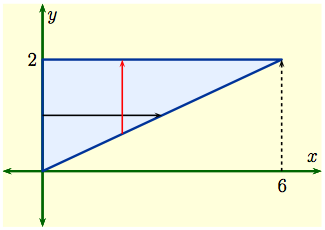
The region of integration is the blue triangle shown on the left, bounded below by the line $y=\frac{x}{3}$ and above by $y=2$, since we are integrating $y$ along the red line from $y=\frac{x}{3}$ to $y=2$. Since we are integrating $x$ from 0 to 6, the left edge of the triangle is at $x=0$, and we integrate all the way to the corner at $(x,y)=(6,2)$.

Treating this as a Type II region, we fix $y$ and integrate with respect to $x$ along the black line. Then $$I \ = \ \int_0^2 \left(\int_{0}^{3y}\, x\,\sqrt{1+y^3}\, dx\right)dy\,.$$ Now the inner integral is easy, and gives $$\int_{0}^{3y}\, x\, \sqrt{1+y^3} dx\ = \ \Bigl[\,\frac{1}{2}x^2\sqrt{1+y^3}\, \Bigr]_0^{3y} \ = \ \frac{9}{2}y^2 \sqrt{1+y^3}\,,$$ with the ugly factor of $\sqrt{1+y^3}$ just coming along for the ride. We then have $$I =\int_0^2 \frac92 y^2 \, \sqrt{1+y^3}\,dy = \int_1^9 \frac32 \sqrt{u}\; du = 26\,,$$ using the substitution $u = 1+y^3$.
Reversing the order of integration in a double integral always requires first looking carefully at a graph of the region of integration. Then it's a matter of algebra and inverse functions.


    Example 2: Reverse the order of integration in the iterated integral $$I \ = \ \int _0^2\left(\int_{x^2}^4\, f(x,\,y)\, dy\right)dx\,,$$ but make no attempt to evaluate either integral.

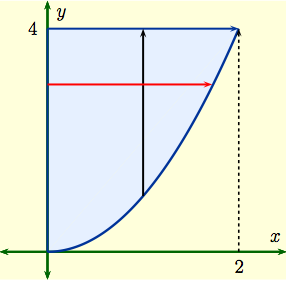
    Solution: The region of integration is the set $$D \ = \ \Bigl\{\,(x,\,y) : \, x^2 \le y \le 4\,, \ \ 0 \le x \le 2\,\Bigr\}$$ whose graph is shown to the right . The given repeated integral fixes $x$ and integrates with respect to $y$ along the vertical black line. To reverse the order of integration we need to fix $y$ and integrate with respect to $x$ along the red line. To set up the repeated integral we have to express $D$ in the form $$D \ = \ \Bigl\{\,(x,\,y) : \, \phi(y) \le x \le \psi(y)\,, \ \ c \le y \le d\,\Bigr\}$$ for suitably chosen $c,\, d$ and functions $\phi(y),\, \psi(y)$.

    Now by inverse functions, the parabola $y = x^2$ can be written as $x = \sqrt{y}$; this tells us how to find the right hand limit of integration $x = \psi(y)$.


    On the other hand, the graph above shows the left hand limit is $x = 0$. Thus $D$ can also be written as $$D \ = \ \Bigl\{\,(x,\,y) : \, 0 \le x \le \sqrt{y}\,, \ \ 0 \le y \le 4\,\Bigr\}\,.$$ Consequently, reversing the order of integration shows that $$I \ = \ \int _0^4\left(\int_0^{\sqrt{y}}\, f(x,\,y)\, dx\right)dy\,,$$ integrating now first with respect to $x$.

Warning: The tricky part of swapping the order of integration is re-writing the limits of integration. This involves studying the region of integration. $$\int_a^b \int_{y=g(x)}^{h(x)} f(x,y) dy\, dx$$ does NOT become $$\int_{g(x)}^{h(x)} \int_a^b f(x,y) dx\, dy \hbox{ !!}$$