|
Investigate the interactive figure to the right.
Use the Triangle Law to interpret ${\bf r}(t+h) - {\bf r}(t)$ as the green vector.
(i) How does this green vector correspond to the 'rise' in the scalar-valued case? (ii) What properties of vectors are needed to identify the Newtonian Quotient with the brown vector? How does the brown vector correspond to slope? (iii) The Newtonian Quotient approaches the tangent vector to the graph of ${\bf r}(t)$ at $P$ as $h \to 0$. |
|
Start with
$$z \ = \ f(x,\, y) \ = \ 3x^2 -y^2 -x^3 +2$$
whose graph is shown to the right. Then
$$f_x \ = \ \frac{\partial f}{\partial x} \ = \ \frac{\partial } {\partial x}\, \bigl( 3x^2 -y^2 -x^3 +2\bigl) \ = \ 6x -3x^2 \,.$$
To exploit interactivity, fix $y = -1$ and use the 'Fix $y$'-slider to intersect the graph of $f$ by the plane $y = -1$. The cubic curve of intersection shown in orange
is the graph of the vector function
$${\bf r}(x)\, = \, \bigl\langle\, x,\, -1,\, f(x,\,-1)\,\bigl\rangle\,=\, \bigl\langle\, x,\, -1,\, 3x^2 -x^3 +1\,\bigl\rangle\,,$$
(use 'Curve 1'-slider). The tangent vector to this orange curve is
$${\bf r}'(x)\ = \ \bigl\langle\, 1,\, 0,\, 6x -3x^2\,\bigl\rangle \ = \ \bigl\langle\, 1,\, 0,\, f_x\,\bigl\rangle\,,$$
(use 'Tangent Vector 1' button). Thus $f_x$ gives the slope of the graph of $z = f(x,\,y)$
in the $x$-direction.
If we fix $x= 1$, say, and use the other sliders and button, we see that $f_y$ gives the slope of the graph of $z = f(x,\,y)$ in the $y$-direction. Thus |
At a point $P=(a,\,b,\, f(a,\,b))$ on the graph of $z = f(x,\, y)$,
the value $\displaystyle\frac{\partial f}{\partial x}\Bigl|_{(a,\,b)}$ is the Slope in the $x$-direction,
$\displaystyle \Bigl\langle \, 1,\, 0,\, \frac{\partial f}{\partial x}\Bigl|_{a,\,b}\,\Bigl \rangle$ is
the Tangent Vector in the $x$-direction, while
$$\frac{\partial f}{\partial y}\Bigl|_{(a,\,b)}\,, \qquad \qquad \Bigl\langle \, 0,\, 1,\, \frac{\partial f}{\partial
y}\Bigl|_{a,\,b}\,\Bigl \rangle$$
give the respective slope and tangent vector at $P$ in the $y$-direction.
|
|
Example 4: determine whether $f_x ,\ f_y$ are positive, negative, or zero at the points $P,\ Q, \ R,$ and $S$ on the surface to the right.
Solution: at $Q$, for instance, the surface slopes up for fixed $x$ as $y$ increases, so $f_y\bigl|_{Q} > 0$, while the surface remains at a constant level at $Q$ in the $x$ direction for fixed $y$, so $f_x\bigl|_{Q}= 0$. On the other hand, $$f_x\bigl|_{R} \,=\,0,\quad f_y\bigl|_{R} \,>\, 0\,, \qquad f_x\bigl|_{P} \,<\, 0,\, \quad f_y\bigl|_{P} \,=\, 0 \,.$$ But what happens at $S$? |
|
|
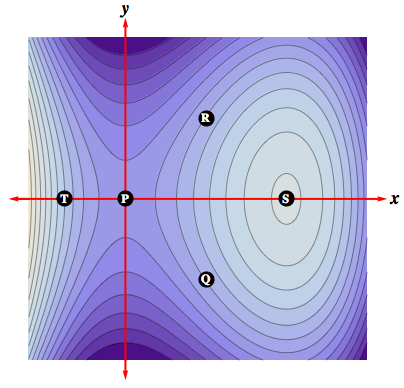
Example 5: To the right is the contour map of the earlier function
$$z \ = \ f(x,\, y) \ = \ 3x^2 -y^2 -x^3 +2\,,$$
with 'higher ground' being shown in lighter colors and 'lower ground' in darker colors. Determine whether $f_x,\, f_y$ are positive, negative, or zero at $P,\, Q,\, R,\, S$, and $T$.
At $R$, for instance, are the contours increasing or decreasing as $y$ increases for fixed $x$? That will indicate the sign of $f_y$. But what happens at $P$ or at $S$. Don't forget that the graph of $f$ appears in the earlier interactive animation! |
|