Multi-scale mechanical modeling of DNA
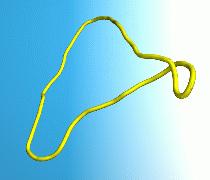
Snapshots of DNA centerlines reconstructed from cryo-EM data.
|
|

|
Related Articles
O. Gonzalez & J.H. Maddocks (2001) ``Extracting parameters for
base-pair level models of DNA from molecular dynamics
simulations,'' Theoretical Chemistry Accounts,
vol. 106, pp. 76-82.
A. Stasiak, J. Dubochet, P. Furrer, O. Gonzalez
& J. Maddocks (1999) ``DNA: Uncooked, al Dente, or Scotti?,''
Science, vol. 283, No. 5408 (March 12), p. 1641.
``On the statistical mechanics of rigid bodies
and polymer chains,'' working manuscript.
``Statistical and dynamical models of DNA in
solvent,'' working manuscript.
Overview
A fundamental problem in the mechanical modeling of DNA is to
determine properties of structure (such as shape, stiffness,...) given
sequence (TAAACG...) and environment (solvent, temperature,...).
The notion of structure and environment depend on length scale,
and my interest is when DNA structure may be described by a
continuous curve and environment by a continuous fluid.
In this case, an elastic rod subject to electrical, hydrodynamic
and random loads provides a reasonable mechanical model of DNA.
Electrical loads may be defined by a (screened) Coulombic interaction
potential, hydrodynamic loads by slender-body theory,
and statistical properties of random loads by a
fluctuation-dissipation relation. My research is concerned
with the general investigation of such a stochastic PDE model.
I am particularly interested in how to determine
rod model parameters (geometrical and constitutive) from
short-scale, atomistic information. Moreover, I am interested
in using the model to help explain experimental data
on large-scale DNA configurations.
Problems of Interest
I. Determination of rod model parameters from molecular
dynamics simulations
What is the unstressed shape and flexibility
of a given DNA sequence in a given solvent?
This information enters any reasonable model of
DNA through the "material parameters" and is
difficult to measure directly. For a continuum
rod model, these parameters can be extracted
from state-of-the-art molecular dynamics (MD)
simulations of short DNA segments in solvent.
The key idea to this stochastic multi-scale matching
is to consider an intermediate system of
interacting rigid bodies in a heat bath.
This system has a dual interpretation: it is a coarse
model of the all-atom system, and a fine
(spatially-discrete) model of the continuum rod
system. This dual interpretation can be exploited
to connect rod parameters to MD data assumed
to be in statistical equilibrium.

Our stochastic multi-scale matching is based on three
observations. First, spatial discretization of the rod
model leads to equations analogous to those governing a
system of interacting rigid bodies in a heat bath.
Second, the long-time statistical behavior of this rigid body system
is governed by a known invariant measure. This measure
provides explicit connections between the rigid body
(or discretized rod) constitutive parameters and the averages
of certain functions. Third, approximate numerical values for these
averages can be deduced from statistical data produced
by MD simulations. This leads to numerical values for the
constitutive parameters. There are current plans to implement
this program using MD data produced by the Lavery group
(CNRS, Paris).
II. Interpretation of cryo-electron microscopy
data of DNA molecules.
There are various experimental methods for studying DNA
configurations. These methods range from indirect
spectroscopy techniques in which DNA shape is extracted from
spectroscopic signals, to direct techniques like classic
electron microscopy (EM). In classic EM one can directly
observe DNA shape, however, this observed shape is influenced
by many "uncontrollable" factors. These factors are connected
with the EM specimen preparation process in which DNA molecules
are adsorbed onto supporting films (which may distort the
DNA shape). The cryo-EM technique is a direct method for
studying DNA configurations that in some sense overcomes, or
bypasses, the drawbacks of classic EM. In the cryo-EM method,
DNA molecules are suspended in a thin layer of fluid,
which is then cryo-vitrified (flash-frozen). It is believed
that the flash-freezing process does not greatly distort
the DNA shape, and that the resulting data represents something
like a snapshot of a thermally-fluctuating DNA molecule.
A continuum rod model of DNA as described above will provide
a basic tool with which to test these conjectures and
better interpret cryo-EM data. For example, with the model
we should be able to answer questions such as the following:
- Does a DNA molecule have sufficient time to
change its shape during flash-freezing?
- Does the "ensemble of shapes" observed in cryo-EM data
correspond to an equilibrium ensemble of the dynamics?
If so, what is the "effective temperature"?
III. Probing unstressed shape and flexibility of DNA.
One indirect way to quantify unstressed shape and
flexibility of DNA is through cyclization or looping
probabilities of relatively short molecules
(about 200bp). Roughly speaking, a cyclization
probability is the probability (steady-state in time)
that a linear piece of DNA will close to form a loop.
Cyclization probabilities are believed to be
very sensitive to unstressed shape and flexibility,
and so would provide a means to validate, and
perhaps even determine, shape and flexibility data.
The basic idea here is to experimentally measure
cyclization probabilities for a number of different
DNA molecules, and then to match this data with
a continuum rod model as described above.
This program has already been implemented with
a static equilibrium rod model (no solvent, zero
temperature) with some success by Manning
and coworkers.
The computational data captures
very well the overall trends in the experimental data,
but there is a systematic error which is likely
attributable to the fact that thermal fluctuations
("entropy effects") are being neglected. A continuum
rod model of DNA that accounts for thermal fluctuations
will provide a basic tool to better understand and exploit
experimental data on cyclization probabilities.
IV. Energy localization, denaturation.
Is it possible for torsional waves, or more generally,
internal elastic energy, to become localized at specific
sites along a thermally-fluctuating DNA molecule?
Torsional waves may be excited along a DNA axis in the
process of transcription. With a continuum rod model
of DNA as described above it will be possible to study the
motion of such torsional waves and determine if energy can
be localized at specific sites depending on the presence
of local areas of sharp natural curvature, rapid variation
in material parameters, etc. It is believed that an
understanding of a mechanism for energy localization, taken
together with Benham's model for the denaturation of the DNA
double helix, may lead to predictions as to the probability
of localized DNA denaturation during transcription and other
biological processes.
Back to home page,
Back to research page