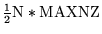
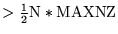
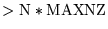
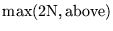
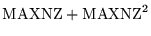
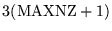
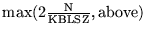
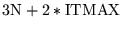
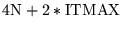
In this section, estimated maximum requirements in NSPCG for real and integer workspace are given. These values should be used initially for the NW and INW parameters in the NSPCG calling sequence, and parameters WKSP and IWKSP should be dimensioned to at least NW and INW, respectively. If insufficient real or integer workspace is provided, a fatal error occurs with IER set to -2 or -3 and NW or INW set to the amount of workspace needed at the point execution terminated. Thus, an easy way to determine storage requirements is to run the package repeatedly using the values of NW and INW suggested by NSPCG from the previous run until enough workspace is supplied. On the other hand, if sufficient real and integer workspace is provided, NW and INW are set on output to the amount of real and integer workspace actually required. Thus, workspace requirements can be reduced to these levels when rerunning the same problem.
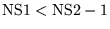
Workspace requirements can often be reduced if the user chooses certain IPARM quantities carefully. For the symmetric accelerators, the choice of stopping test, as determined by NTEST [= IPARM(1)], has no effect on workspace requirements. For the nonsymmetric accelerators, some stopping tests can increase storage demands by up to 3N. Thus a stopping test should be chosen which is efficient in time and memory. See Section 10 for information regarding the selection of stopping tests in the nonsymmetric case. Also, 2N integer workspace can be saved if the user informs NSPCG whether or not matrix A has Property A if this property affects a preconditioner. This is done by setting IPROPA [= IPARM(18)] appropriately.
In the following formulas, let
N
be the problem size
MAXNZ
be the active column width of the COEF array
ITMAX
be IPARM(2)
NS1
be IPARM(9)
NS2
be IPARM(10)
LVFILL
be IPARM(16)
LTRUNC
be IPARM(17)
IPROPA
be IPARM(18)
KBLSZ
be IPARM(19)
NBL2D
be IPARM(20)
ISYMM
be IPARM(23)
NV
be

NH
be

NBLK
be N/NBL2D
NFACTI
be the number of diagonals in the factorization
NCMAX
be the maximum number of nodes of the same color in a
multicolor preconditioner
KEYGS
be the gather/scatter switch set in routine DFAULT
(see Section 18 for details on this switch)
DB
be the full bandwidth of
 where
where
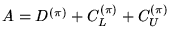
in block notation
DHB
be the half bandwidth of
ABAND
be the full bandwidth of matrix A, in 2-D blocks
(e.g., ABAND = 3 for a 3-D 7-point operator on a box)
Then

As noted above,
 if
if
 accel
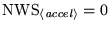
accel  is CG, SI, SOR, SRCG, or SRSI, and can be up to a maximum of
 otherwise. A table giving the real workspace required for
each accelerator,
otherwise. A table giving the real workspace required for
each accelerator,
 , is given below, followed
by a table giving the real and integer workspace required for each
preconditioner,
, is given below, followed
by a table giving the real and integer workspace required for each
preconditioner,
 and
and
 . Finally, a table is shown giving
real and integer workspace requirements for factorizations for certain
preconditioners,
. Finally, a table is shown giving
real and integer workspace requirements for factorizations for certain
preconditioners,
 and
and
 .
.
accel
CG
SI

SRCG
SRSI
SOR

BASIC
ME

CGNR
LSQR

ODIR

OMIN

ORES

IOM

GMRES

Add
 if IQLR =2 or 3
Add
 if
if
USYMLQ

USYMQR

LDIR

LMIN
LRES

BCGS
CGCR
OMIN workspace plus

and
precon
RICH1
0, N if KEYGS = 1
0
JAC1
0, N if KEYGS = 1
0
SOR1
N
0
SSOR1
N,
if ISYMM = 10
IC1
N
0
MIC1
N
0
LSP1
,
if KEYGS = 10
NEU1
N,
if KEYGS = 10
RICH2
0
0
JAC2
0
0
LJAC2
0
0
LJACX2
0
0
SOR2
0
MAXNZ
SSOR2
0
MAXNZ
IC2
0
NFACTI
MIC2
0
NFACTI
LSP2
0
NEU2
N
0
and
,
cont.
precon
LSOR2
0
0
LSSOR2
N
0
BIC2
KBLSZ
0
MBIC2
KBLSZ
0
BICX2
KBLSZ
0
MBICX2
KBLSZ
0
LLSP2
0
LNEU2
0
RICH3
0
0
JAC3
0
0
LJAC3
0
0
LJACX3
0
0
SOR3
0
MAXNZ
SSOR3
N
MAXNZ
IC3
0
NFACTI
MIC3
0
NFACTI
LSP3
0
NEU3
N
0
LSOR3
0
0
LSSOR3
N
0
BIC3

0
MBIC3
0
BICX3
0
MBICX3
0
LLSP3
0
LNEU3
0
RICH4
0,
if KEYGS = 10
JAC4
0,
if KEYGS = 10
LSP4
,
if KEYGS = 10
NEU4
N,
if KEYGS = 10
RICH5
0,
if KEYGS = 10
JAC5
0,
if KEYGS = 10
LSP5
,
if KEYGS = 10
NEU5
N,
if KEYGS = 10
SOR6
N
0
SSOR6

0
IC6
N
0
MIC6
N
0
RS6
0
SOR7
0
0
SSOR7
N
0
BIC7

0
MBIC7
0
BICX7
0
MBICX7
0
RS7
N
0
|